1. Introduction
Human activity has become a dominating force of Earth system dynamics in the Anthropocene, pushing against planetary boundaries, and resulting, for example, in climate change and loss of biodiversity.1 This twin challenge disproportionally affects communities living off the land, including Indigenous peoples.2 Many Indigenous communities are renowned for having developed long-term resilience and successfully adapted to changing social-ecological conditions.3 However, the speed and novelty of current climate change alongside landscape loss and fragmentation driven largely by competing land use and infrastructure development, compromise the applicability of such strategies. Put differently, the linked systems of landscapes and Indigenous cultures are decoupling at an increasing rate.4 This pushes the structure and function of traditional Indigenous lands beyond any earlier experience and limits options for the future.5 Inevitably, traditional livelihoods and practices that have worked for centuries are now challenged and new ways of engaging with the landscape need to emerge. This raises questions of how Indigenous cultural integrities can be preserved, how desirable adaptation can be enacted, and how to avoid that Indigenous communities become ‘strangers on their own land’.6
Here, we approach adaptation as a social and intentional process, embedded in complex and localized decision-making landscapes to maintain or achieve a desired state. Adaptation thus comprises individual and community-based decision-making and practices: informed actions aimed to pave the way for desirable outcomes while reducing exposure and sensitivity to conditions perceived as detrimental.7 Central questions to understand the concept of adaptation thus include which knowledge counts, whose values count, and who gets to decide what is desirable or not8, or as Morchain9 states: “allow knowledge which remains marginalized to become influential”. These questions can only be meaningfully answered by taking departure in the recognition and in-depth understanding of Indigenous peoples’ lived experiences, needs, value systems, practices, and localized decision-making processes. These aspects form the basis of Indigenous knowledge (hereafter IK)10, highlighting the unique, holistic and place-based quality of such knowledge systems. IK integrates the knowledge of past generations with the reality of the present, and includes worldviews, ethics and values that give meaning to the environment.11 The holistic nature of IK describes what is seen as a desirable state in human-environment relationships.12 IK thus forms a basis for understanding adaptation from Indigenous viewpoints, with the key word being desirable. Adaptation policies and actions must be attuned to Indigenous values and seen as desirable by the communities and rights-holders primarily concerned, otherwise they will likely reinforce vulnerability and existing inequalities, which may lead further down maladaptive pathways.13
Maladaptation comprises the negative consequences of intentional policies and measures, for example by increasing or shifting vulnerabilities for targeted groups or society as a whole.14 What is a desirable measure for one actor or group may thus have (unintended) negative consequences for others. Adaptive measures that reinforce existing inequalities, push already marginalized actors further behind, or violate human rights, fail in their objective of contributing to fair, just and equitable adaptation and should therefore be considered maladaptive. Drawing on Juhola et al.15, we position adaptation and maladaptation as ends on a continuum, ranging between desirable and undesirable effects for targeted groups and society. Maladaptation is in many cases a reality and threat for many natural resource-dependent communities and Indigenous peoples, including the reindeer herding Sámi in Northern Fennoscandia, recognized as one of the most vulnerable groups to climate change.16 Research shows that many of the historically preferred adaptions for reindeer herders in Northern Sweden are no longer available, such as the rotation between different grazing areas or the cutting of trees rich in arboreal lichens as emergency forage during adverse snow conditions.17
In this paper, we examine and discuss the contested issue of supplementary feeding against the conceptual continuum of adaptation-maladaptation, i.e., what herders perceive as desirable or not, and what drives their land use decisions and adaptations at the landscape level. The case revolves around the urgency and policy tensions surrounding decisions and options of letting the reindeer (Rangifer t. tarandus) graze freely on natural grazing resources during winter vis-à-vis supplying the herd with supplementary feeding.18 On the one hand, different forms of supplementary feeding have always been needed as an emergency response in reindeer herding as part of its inherent resilience.19 Today however, the confinement of adaptation options is primarily driven by external forces, including resource extraction such as forestry and is exacerbated by climate change.20 Importantly, this includes the reduction of winter forage resources for reindeer, i.e., terrestrial lichens (Cladonia ssp.) and arboreal lichens (Alectoria sarmentosa, Bryoria fuscescens)21, as well as climate change which increasingly brings about adverse snow conditions that prevent reindeer from digging for their forage.22
The situation is further complicated by insufficient recognition of Sámi rights, needs and knowledge in present land use governance and planning.23 It is not only a matter of a lack of available knowledge or information but, as research on the green energy transition shows, results from fundamental goal conflicts over the land, deep-rooted power asymmetries and how private and public actors are able to systematically and strategically ignore both available knowledge and international standards, such as the principle of free, prior and informed consent, in land use interactions.24 Institutionalized procedures are typically fragmented between different policy and decision-making arenas and therefore fail to reflect and recognize herders’ holistic and systemic relations to the land.25 This has led to increasing conflicts as well as a communicative burden placed on herding communities which is further exacerbated as many land use interactions are delegated from the state to industry-community negotiations.26 The risk is evident that herders may be forced into undesirable maladaptive trajectories. Herein, supplementary feeding is one of the major concerns: widespread skepticism remains among herding communities in Sweden, as providing supplementary feeding in a routinized manner is associated with significant environmental and socio-economic risks, as well as possible negative impacts on cultural identity, reindeer well-being and the relationship with the surrounding society.27
The aim of this paper is to map the relations and connections between multiple factors and decisions present in reindeer herders’ decision-making regarding supplementary feeding. We seek an understanding of what system characteristics they consider as desirable and adaptive versus undesirable or maladaptive for their livelihood. We explore the complexity surrounding their decision-making to maintain these desired system characteristics, grounded in their IK. Specifically, we ask which factors surround decisions to feed or to avoid feeding, what drives feeding, and what other adaptation options are available to herders. We use focus-groups combined with Fuzzy Cognitive Mapping (FCM), a semi-quantitative approach to identify key forcing variables that affect decision-making and causal relationships between them, identified by reindeer herders from their daily experiences. By focusing on herders’ IK (in terms of perspectives, values and practices), our approach engages the herders to describe the way they see interactions between different factors influencing their decisions whether to feed or not, and also to set the boundaries of that understanding. Our systems-oriented approach thus reflects underlying principles of the herders’ IK and decision-making landscapes, where the borders between the social, cultural, and ecological are often much more fluid than in conventional western scientific approaches.28
2. Material and methods
2.1. Case description
In Sweden, reindeer herding is practiced exclusively among the Indigenous Sámi. Their historical and continuous land use has established property rights, founded on immemorial prescription, in the so-called Reindeer Herding Area (RHA).29 Reindeer herding is moreover recognized as an integral part of the Sámi culture and is protected by the Swedish constitution and in international law, for example in Article 27 of the UN International Covenant on Civil and Political Rights (ICCPR). This article has recently been acknowledged in Sápmi, the traditional homeland of the Sámi people, in relation to wind power development on reindeer herding land, where the Norwegian Supreme court has ruled that an established park has violated human rights.30
The RHA covers about 50% of the Swedish land area (fig. 1). It is divided into 51 herding communities (samebyar), a geographic unit and legal entity that represent the interests of its reindeer herding members. Reindeer herding can be practiced in the entire RHA, on both state-owned and privately owned land. The interactions between herding communities and other land users, such as forestry and mining, are not clearly regulated in the sectoral legislation31 which has led to infected land use conflicts and rapidly deteriorating conditions for reindeer herding.32
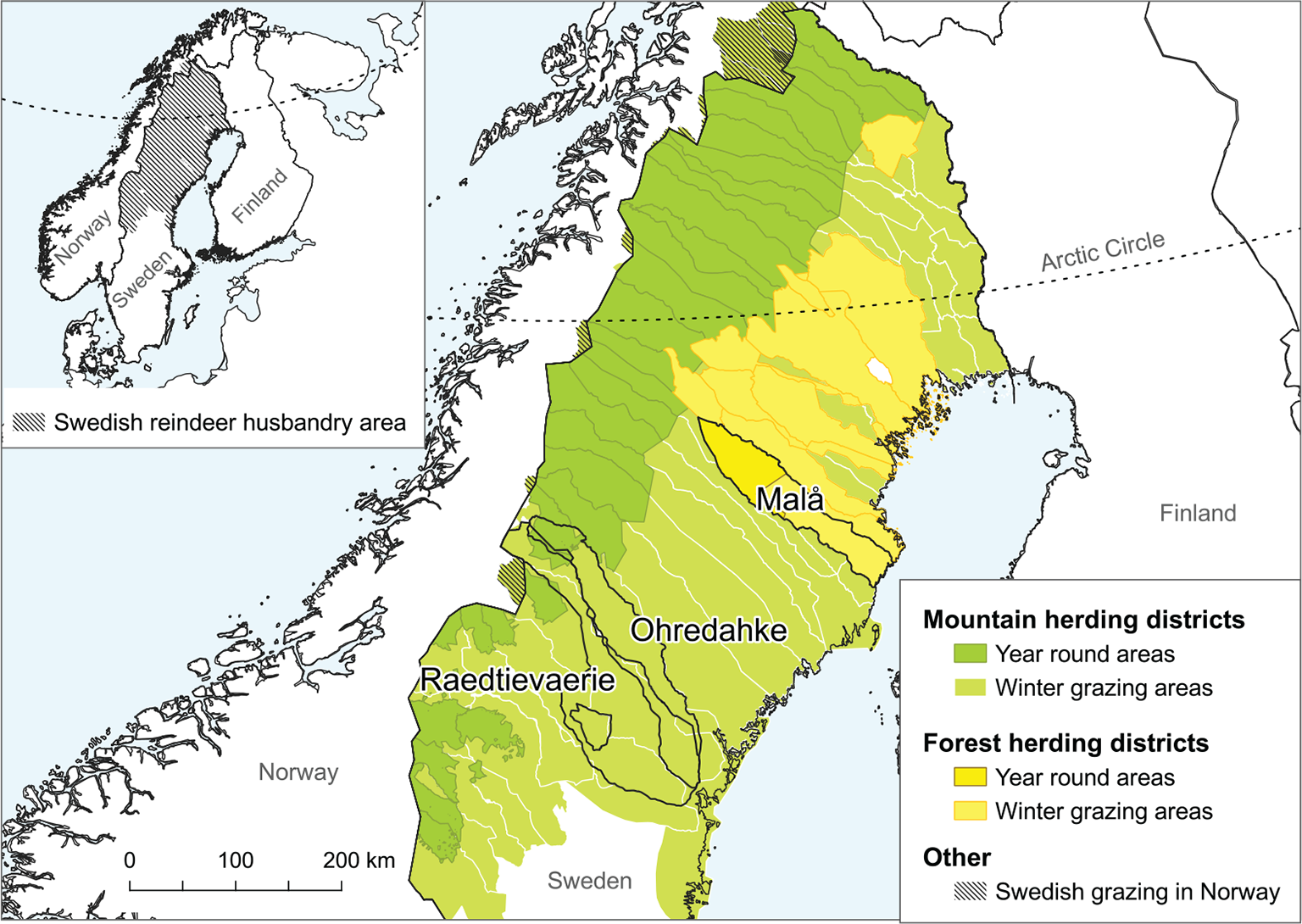
Figure 1. Location of the herding communities that participated in the study. Year-round areas and winter grazing areas are shown. The inset map illustrates the Swedish reindeer husbandry area.
With ancient roots, reindeer herding is today an extensive form of land use relying on large season-specific natural grazing grounds, reflecting the seasonally fluctuating availability of forage resources.33 Two different systems of seasonal rotation between summer and winter grazing grounds exist. In mountain communities, reindeer spend the summer in the mountains at the border to Norway. In late autumn, they migrate either on foot or are transported in trucks (e.g. due to disrupted migration routes) to their winter grazing areas in the lowland forests. In spring, reindeer return for calving to the summer areas. Contrastingly, reindeer in forest communities spend all seasons in the boreal forest but select different seasonal grazing grounds within that area.
2.2. Study areas: Raedtievaerie, Ohredahke and Malå herding communities
The need, regularity and quantity to provide reindeer with supplementary feeding differs widely within the Swedish reindeer husbandry area.34 In the past decades, however, herders have experienced difficult winter grazing conditions with increasing frequency.35 To understand how the needs and strategies of supplementary feeding are affected by the availability of, and access to, natural grazing resources in interaction with other important factors, we focus on communities that differ in their herding practices and environmental settings. After consultation with the Swedish Sámi Association (SSR), we identified three communities to approach, two migratory communities in the southern part of the reindeer herding area and a forest community further north.
The herding communities Raedtievaerie and Ohredahke in Jämtland County (fig. 1) represent mountain communities, with close family ties between the communities. Herders from these two communities share common winter grazing areas and therefore participated together in the workshop. We group both communities as one functional unit in the remaining analysis. The reindeer herd size in winter, i.e. after slaughter, is c. 2,500 animals in Raedtievaerie, and c. 3,500 in Ohredahke. Both Raedtievaerie and Ohredahke have experienced the destruction of traditional migration routes between seasonal grazing grounds by hydropower development in the 20th century, as well as forestry having a major impact on their grazing land and land use patterns.
The third community, Malå, is a forest herding community in Västerbotten County (fig. 1). The winter herd size in Malå is c. 4,500 animals. Malå experiences strong competition and multiple pressures by developing infrastructure, forestry operations, and wind power development.
2.3. Initiating collaboration
In our research we engaged in dialogue with reindeer herders before, during and after empirical data co-production. Upon having identified potential communities, the first author made initial visits to the herding community in the fall of 2017, such as participating in reindeer gatherings. We engaged in further dialogue with the respective herding community, who selected herders or community members willing to participate in focus groups. At all stages of the collaboration, we followed the research policy adopted by the Swedish Sámi Association, including the principle of free, prior and informed consent (FPIC) to participate in the project.36
The size of the herding communities differs, so for Raedtievaerie/Ohredahke most of the herders participated (Raedtievaerie/Ohredahke: n = 6). In Malå, several herders had to cancel their participation last minute to tend to their herds due to difficult snow conditions (Malå: n = 4). The focus groups took place separately in January and March 2018 and each lasted for approximately six hours. The age of participants ranged between early twenties and sixties. Only one female herder was present (Raedtievaerie/Ohredahke), which reflects the male dominance in the livelihood, at least in the daily practices of reindeer herding. Participants received renumeration for their participation, in accordance with guidelines from the Swedish Sámi Parliament as well as research ethical considerations.37
2.4. Fuzzy Cognitive Mapping – capturing complexity and understanding the system
Indigenous Knowledge, such as that held by reindeer herders, uses language-based, rather than number-based prescriptions to describe and evaluate human-environmental interactions and conditions, what can be conceived as systems.38 Holders of IK may thus use a diverse set of “simple”, but culturally important indicators to draw holistic representations of their lifeworld.39 Comparisons between different system states are based on perceived qualitative ranks of variables that otherwise might be hard to quantify, such as the cultural dimension. These variables interweave into a “mental landscape” as cognitive representation of their reality.40
A method for capturing and structuring these mental landscapes in a graphic representation is Fuzzy Cognitive Mapping (FCM).41 In the process of FCM, stakeholders identify key concepts that compose their system and describe causal relationships between them. The strengths of causal relationships between concepts are characterized as “weak” to “strong”, based on the qualitative description by the stakeholders usually given in the interval [–1; +1].42 Positive strengths signify amplifying relationships, causing linked concepts to change in the same direction. Negative strengths indicate opposing relationships, i.e., a decrease or increase in a given concept leads to the opposite change in a linked concept. The overall significance of a concept in the map, i.e., its centrality, is given by the absolute sum of outgoing relationships (affecting other concepts) and incoming relationships (affected by other concepts). Our approach also enables the description and understanding of how herders perceive feedback within and between ecological and social phenomena, which can coproduce system dynamics that often are non-linear and difficult, or even impossible, to foresee.43 This demonstrates why decision-making in social-ecological settings in general, and adaptation in particular, is so difficult and fraught with uncertainty.
2.5. Constructing the maps in focus groups and post-procession
Focus group pertains to in–depth discussions with a group of purposefully selected participants that focus on a specific question.44 In the focus groups we conducted, participants were free to expand on any topic they considered relevant. The focus groups were constructed as workshops where participants constructed conceptual maps using paper, pens and sticky notes, continuously engaging in discussion with each other and with the researchers. Participants identified important factors based on the specificity of their herding community, ranging from particular sites to encompassing the entire area, including the reindeers’ body condition and behavioral changes, daily herding practices, industrial resource development, predator populations and policies, and trends in climate and weather events. Discussions around identifying key concepts often involved very personal experiences and sharing of stories, a common way to communicate knowledge and meaning. The entry points for the discussion and subsequent construction of maps were ‘supplementary feeding’ and ‘natural grazing’, representing two alternative adaptation pathways and regimes regarding reindeer foraging. During the workshop, participants partly challenged and refitted these concepts to better reflect their situation (see Results).
When participants were satisfied with the identification of concepts, they established the causal connections between them. As a last step, participants weighed both amplifying and opposing relationships as “weak”, “moderate” or “strong”. With the participants’ consent, we recorded the discussions and transcribed them verbatim for later reference. A summary of the transcribed interview was sent to the herders for their approval and to give them the opportunity to address possible omissions or misunderstandings.
Due to time constraints in Malå, it was not possible for the participants to finish weighing all the relationships drawn on the maps. Participants identified 26 of the weights, while the first and second author of the paper, both present at the workshops, filled in the remaining 65 with the participants’ consent. Each weight was carefully calibrated against prior discussions using the workshop transcript. The full map was then sent to and discussed with our main contact from Malå, who agreed on the added values. Concepts are presented and defined in tables A1 (R) and A2 (M), based on key phrases from the recorded focus groups.
3. Results
This section describes in the participants’ (P) own words from the recorded focus groups the present-day circumstances in Raedtievaerie/Ohredahke (R) and Malå (M). Cognitive maps were constructed by the herders during the workshops (fig. 2, fig. 3) to illustrate these narratives.
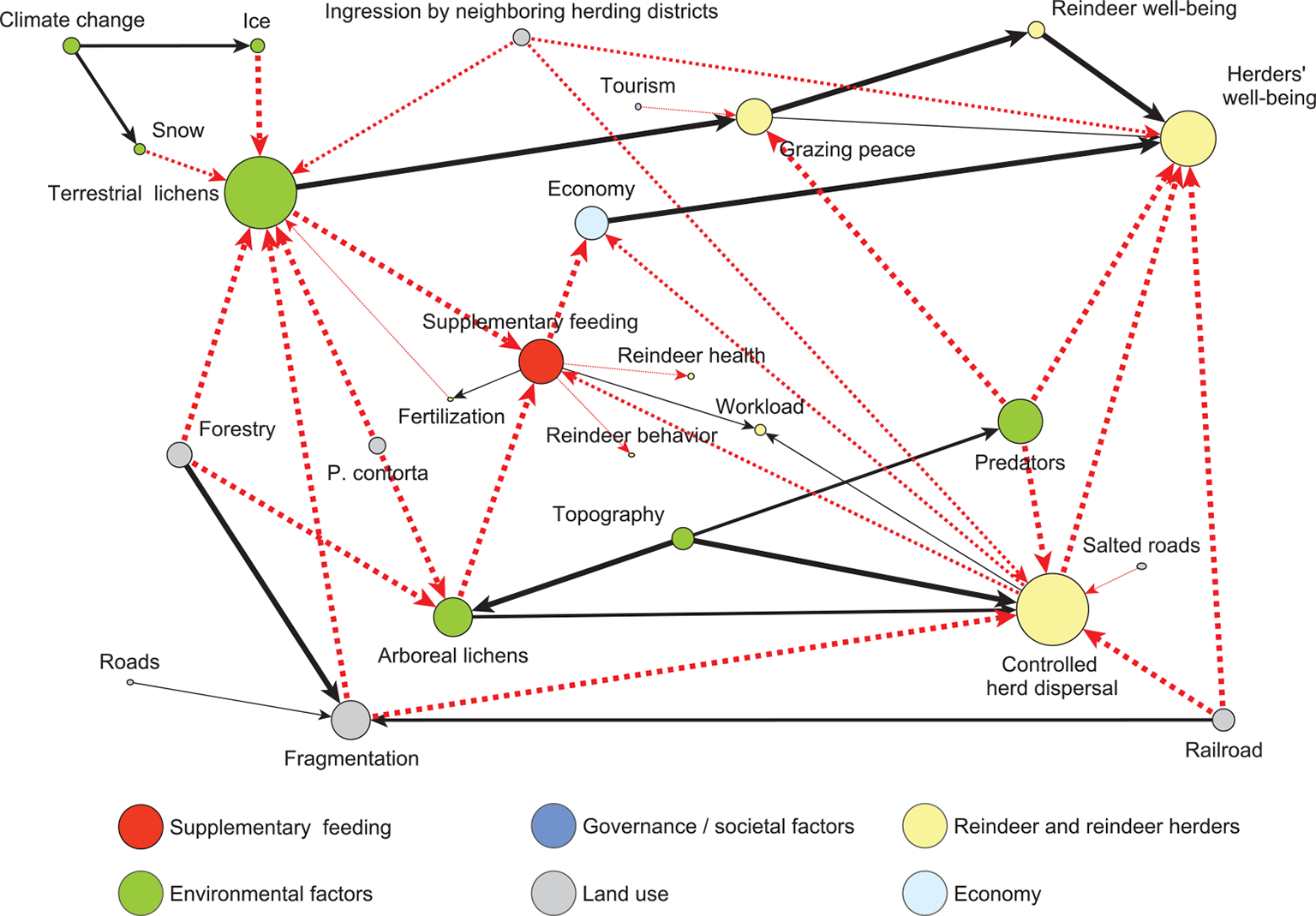
Figure 2. FCM for Raedtievaerie/Ohredahke herding community. Circle size represents centrality, arrow size represents strengths of influence. Dotted arrows in red indicate opposing relationships, full arrows in black indicate amplifying relationships.
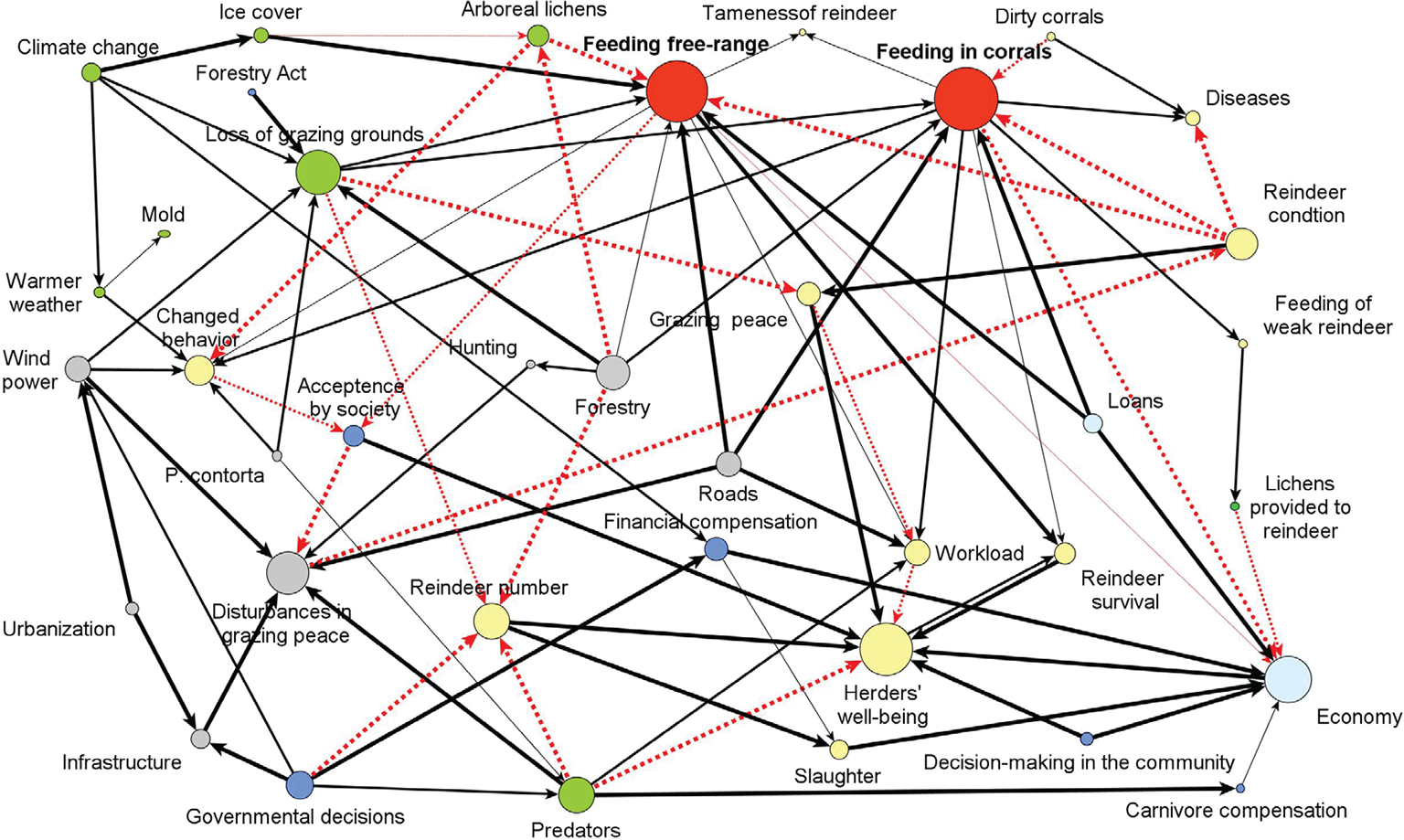
Figure 3. FCM for Malå herding community. Circle size represents centrality, arrow size represents strengths of influence. Dotted arrows in red indicate opposing relationships, full arrows in black indicate amplifying relationships. See fig. 2 for legend.
The communities that participated in the study differ in geographical location, history, herding practices and to some extent exposure to competing land use. Herders themselves describe that “everyone has the same problems. There are only different intensities of these problems” (P3, M). In our study, Malå is, relatively speaking, more exposed to such cumulative problems than Raedtievaerie/Ohredahke. The maps constructed therefore include several similar concepts, such as the impacts of climate or other forms of land use. Yet, important differences exist, depending on the herding strategies possible and other local conditions, as will be shown below.
3.1. What drives needs and decisions regarding supplementary feeding?
Generally, participants understood supplementary feeding as a necessary or unavoidable fact, not a solution or desirable adaptation, to shortages of grazing resources (P3, R). They emphasized many times during the workshops that, “the dream in reindeer herding is to never need to give supplementary feeding” (P4, R). Both groups explained how “natural grazing resources disappear more and more” (P3, M), and that the primary goal was, when needed, “to give some extra feeding” (P4, R) to support the reindeer in their own search for grazing resources, so “that reindeer thrive as much as possible” (P4, R). Supplementary feeding on a larger scale is thus only used to ensure reindeer survival “during crisis” (P2, R) when natural forage resources (terrestrial and arboreal lichens) are inaccessible, and the reindeer are in bad condition. This might be the case if “reindeer can’t get at them because of the snow” (P4, R) or ice-crusts (see below).
The results further highlight the need to view responses to environmental and climate factors in context, in this case confirming how lichen availability is negatively affected by forestry practices and other forms of land use or infrastructure (P1, R; P1, M). Among other things, these include construction of wind power plants, railroads and roads. Herders in both communities emphasized the detrimental consequences of the exotic tree species Pinus contorta on both terrestrial and arboreal lichens – “the grazing resources just die” (P4, R). Furthermore, dense P. contorta plantations offer cover for predators, forcing reindeer to change their behavior around these areas and increasing losses for herders (P4, M). It is noteworthy that herders in Malå, who are strongly exposed to many different parallel forms of land use, framed this process explicitly as “loss of grazing resources” (referring to terrestrial lichens) in their model, while herders in Raedtievaerie/Ohredahke chose to frame it as “[amount of] terrestrial lichens”. While similar processes are considered, they are seen from opposite directions, indicating the relative urgency the communities experience. The map drawn by herders in Malå herding communities contained more concepts than the map drawn by herders from Raedtievaerie/Ohredahke herding communities. This reflects the stronger exposure in Malå to other forms of land use and the use of boreal forests during both summer and winter.
The loss of grazing grounds and increasing infrastructure disrupt the ‘grazing peace’ (guohtun ráfi in Northern Sámi) of the animals, i.e., calmly grazing herds that do not split or do not stray afar in search of forage (P1, P3, R; P3, M). The maps demonstrate how ‘grazing peace’ is directly related to, and increases, the well-being of both reindeer and the herders – not only because calm herds require less herding work, but also because herders feel accomplished by securing their animals’ well-being (P4, M).
Herders pointed out that reindeer can spread over large areas in search of natural forage when snow conditions are difficult – making it very difficult to keep them gathered for supplementary feeding (P1, R) and increasing the risk of traffic accidents (P1, M). This points to practical limits in supplementary feeding as a strategy since, as the herders explain: “supplementary feeding is rarely an alternative when you would need it.” (P3, R). Other alternatives, such as moving to areas with variable topography with diverse grazing conditions and arboreal lichens are clearly the preferred adaptation options (P3, R; P1, M).
In Malå, supplementary feeding has been practiced by necessity almost every year since the late 1990s (P1, M). As two different strategies of supplementary feeding (see below) are established and used regularly in Malå, they received a central place in the FCM, while it was not the topmost concept in Raedtievaerie/Ohredahke (fig. 2, fig. S1).
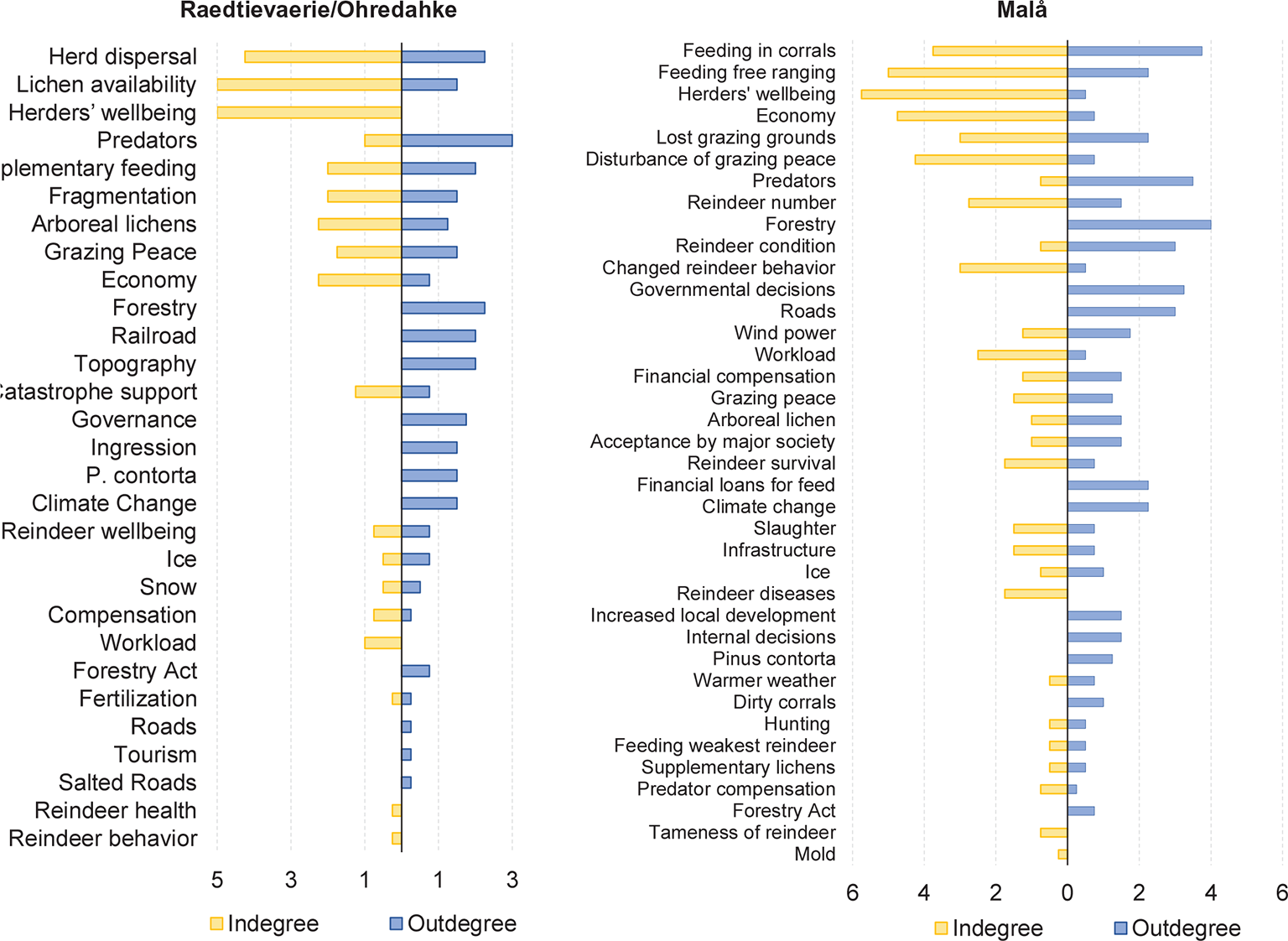
Figure S1. Indices for conceptconcepts derived by the FCM for Raedtievaerie/Ohrendahke (left) and Malå ( right). Incoming relationships (indegree) to the left, outgoing relationships (outdegree) to the right. Concepts are ordered by decreasing centrality, i.e., the sum of in- and outdegreeoutdegree.
3.2. The significance of weather and climate
Stochastic winter weather and its influence on snow conditions influence the availability of the principal natural winter forage for reindeer, i.e., both terrestrial and arboreal lichens. The variation of precipitation and temperature determines if snow freezes to form ice-crusts and thus form a barrier to reindeer foraging. In extreme cases (such as in winter 2017/2018), arboreal lichens in the trees may also be covered by ice, making them unavailable for the reindeer (P1, M). Therefore, even areas with high lichen biomass “can still be bad grazing areas during winter” if reindeer cannot access the forage beneath the snow (P4, R). “Weather has become less predictable” (P1, R) in the last 15 years (P4, M). Reindeer herders observe that what they consider as extreme events, such as “alternating rain and snow…. One day it is plus-degrees and the next day it is –15 below zero, resulting in ice cover” (P2, R) are increasing in frequency, attributed to climate change.
In short, snow conditions determine to a large degree if and when supplementary feeding becomes necessary. While the herders recognize climate change as a central driver in the decision-making process, its fundamental impact is somewhat obscured in fig. 2 and fig. 3, as climate is represented only by outgoing relationships.
3.3. Feeding strategies
Participants emphasized that supplementary feeding does not necessarily contradict traditional forms of reindeer husbandry, where reindeer “move between different grazing grounds, that they find their forage resources on their own” (P4, M). In both communities, herders differentiated between “feeding in corrals” and “feeding free-range”. Feeding free-range, i.e. feeding in the landscape without restricting the animals’ options to move freely, requires that reindeer “can graze at least on some natural resources” (P4, R). It is also a strategy to “have control over the herd” (P1, M), as reindeer then tend to keep closer to the feeding sites, instead of spreading over a large area (P4, M).
Participants in Raedtievaerie/Ohredahke pointed out that feeding in corrals is only a short-term option, for instance to protect reindeer from predators (P3, R). They did therefore not include ‘feeding in corrals’ into their model and emphasized that they “to a larger extent use other alternatives than supplementary feeding” (P3, R). Contrastingly, in Malå both types of feeding received similar focus (fig. 2, fig. A1), but participants emphasized that feeding in corrals “is nothing you strive for. Reindeer should be free and graze on natural resources” (P3, M). Therefore, herders tend to wait as long as possible before starting to feed, also because of economic cost (P1, M). Yet, it is very difficult to know how the winter conditions will be (P1, M). Waiting too long before starting to feed may risk losing animals that are in bad condition and thus cannot cope with the adjustment in the forage, requiring herders to make a quick decision (P4, M).
3.4. Herding strategies
A major difference between the two communities was the option of controlled herd dispersal in Raedtievaerie/Ohredahke, i.e. guarding the edges of the herd when reindeer are moving freely and feeding to a large degree on their own. It helps herders to “know in which area your reindeer are” (P4, R), and supplementary feeding is then applied “not to lose the grip on the herd” (P3, R). Control over the dispersed herd was therefore a strong focus in Raedtievaerie/Ohredahke, together with lichen availability (fig. 2, fig. A1). However, “forestry has today limited this option.” (P1, R) by reducing lichen availability. This process is still ongoing (P3, M) and may force herders to use areas they have never used before as they are exposed to other forms of land use (P4, M). In both maps, forestry therefore was ranked among the highest drivers (fig. A1).
Participants in Raedtievaerie/Ohredahke emphasized their rather large winter grazing area as a strength of their herding community (P1, R). In particular, the diverse topography is an advantage, as it offers variable snow conditions for reindeer foraging, as well as steep terrain inaccessible to forestry operations (P3 & P4, R). That variation allows a controlled herd dispersal, and therefore received a strong focus (fig. A1).
Arboreal lichens are considered “central during bad grazing conditions and in the decision of whether you start supplementary feeding” (P1, R). As arboreal lichens can sustain reindeer when deep or hard snow hinders reindeer to dig for terrestrial lichens, herders would “cope much better. Very, very much would need to happen, before you think about feeding” (P1, R). However, forestry practices have strongly reduced arboreal lichens in both herding communities today. In Raedtievaerie/Ohredahke, protected forests close to the mountains offer some arboreal lichens, however, these forests “accumulate deep snow and there are many predators” (P4, R). Releasing the herd into these forests would result in large losses of reindeer to these predators. In both herding communities, herders perceived predator impacts as very detrimental, and therefore ranked them among the highest drivers in both cognitive maps (fig. A1). Dispersal of the herd and guarding it on the edges is currently not an option in Malå. Participants pointed out that it would give them the chance “to recover some energy. That has not been possible during the last 10–15 years” (P1, M), mostly due to difficult winter conditions. Yet, herders in Malå also use supplementary feeding to have “better control” (P1, M) over the animals.
3.5. Consequences of supplementary feeding on reindeer and herders
Supplementary feeding changes the work with the reindeer in several ways, for instance “it is a lot of work to get out the feed. This is very demanding. At the same time, someone must watch over the reindeer that are still dispersed.” (P3, M). Apart from the increased workload, feeding is expensive, particularly feeding in corrals (P4, M). Financial support from the Swedish Sámi Parliament, granted by the Swedish Government, during winters with extremely difficult snow and ice conditions can be rather important (P4, M). It is paid to the herding community, not to the individual reindeer herder, and these decisions can be delayed. For the reindeer, supplementary feeding can improve their condition when natural forage is unavailable. Especially when feeding free-range, reindeer as herd animals can take advantage of each other, where stronger animals can open feeding craters, which may be used by those animals that refuse to eat from the supplementary feed (P3, M). This process may help reindeer in the adjustment from natural forage to supplementary feeding. Contrastingly, “feeding in corrals can only be sustained over a shorter time due to risk of diseases” (P4, M) and some reindeer refuse to eat, and their body condition deteriorates (P1, M). Feeding in corrals may also have the effect that the “natural behavior of reindeer will be disrupted, their instincts” (P4, R). As reindeer become more used to human presence, they become tamer, which may lead to increased conflicts with the surrounding society, such as traffic accidents (P3, M).
3.6. Self-reflecting on herders’ Indigenous knowledge
The maps constructed can be understood as a visual representation of the herders’ shared IK pertaining to those aspects that were discussed, although not all intricacies can be included. They emphasized that “cultural and place-specific knowledge of the landscape is essential to succeed with supplementary feeding” (P4, R) and for reindeer herding practices at large. However, participants expressed frustration that their knowledge “has no value” (P4, R) or “no credibility” (P3, M) as an evidence-base during consultations with other forms of land use, such as forestry. This leads to a “loss of confidence” (P3, M) to participate meaningfully in land use decisions. In sum, there is a feeling that herders “all the time need to adapt according to the norms of majority society” (P1, M).
Other actors often misunderstand the need of access to land and mobility for reindeer well-being. Competing land use or policymakers may frame providing financial compensation for feeding in corrals as a solution to land use conflicts, so that “you do not need any grazing grounds anymore, only two square kilometers for a corral” (P3, R). Herders view such financial compensation in exchange for grazing land, as a “risk that you are doing something that others [i.e. majority society] want you to do” (P3, R) at the expense of reindeer ecological needs and their own practical and cultural preferences. They further point to the potential loss of Indigenous knowledge on the behavior of reindeer (P2, R).
Despite their long experience and knowledge in caring for their animals, herders acknowledge that reindeer behavior can still surprise them. Reindeer may behave in a different way than herders would expect or desire – potentially affecting the decision on supplementary feeding (P4, M; P1, R).
3.7. Reindeer herders’ well-being
Herders emphasized that reindeer herding “is a way of life. It is the reindeer that matter.” (P4, M). Herders’ well-being involves their psychological, emotional, social as well as physical health. In both communities, the well-being of herders, connected to this way of life, received a high focus in the maps (fig. 2, fig, 3, fig. A1), as it is affected by so many other relationships in both Malå and Raedtievaerie/Ohredahke. The feeling that “sadly, this generation may be the last one that practices traditional reindeer herding” (P4, M) increases the psychosocial burden.
4. Discussion
In this paper we have examined supplementary feeding from the perspective of reindeer herders. We used FCM to illustrate the complexity of the decision-making landscape in which decisions to provide supplementary feed takes place. We begin by discussing what these maps tell us broadly about the situation for herding, as well as what we learned when we compared the maps to each other. Thereafter we move on more concretely to discuss what to make of supplementary feeding on an adaptation-maladaptation continuum.
4.1. The utility of FCM to illustrate complexities in decision-making
The herders in the two communities work in similar environmental conditions during winter. Their cognitive maps thus show several similarities, reflected in the herders’ narratives regarding the identified concepts and principal relationships. This applies to relationships both within and between biotic, abiotic, and socio-cultural and economic variables, and challenges posed by the surrounding society. The role of weather events and forestry on the availability of grazing resources and presence of predators are particularly influential in the adaptive decision-making on supplementary feeding and other herding strategies, thus strongly affecting reindeer herders’ well-being.
However, important differences became obvious in the two cognitive maps. One striking difference is that herders in Malå consider two forms of supplementary feeding, i.e., free-range as well as in corrals. Herders in Raedtievaerie/Ohredahke do not consider the latter, except in the rare case of particularly damaging predator presence (wolves). Furthermore, we noted the opposing framing of natural grazing resources in the maps. Herders from Raedtievaerie/Ohredahke termed this as availability of “terrestrial lichens” (fig. 2), while herders from Malå oriented the map and its relationships on the “loss of grazing resources” (fig. 3). While this may be considered the same concept seen from different viewpoints, it also reflects the major processes that determine herding practices and herders’ concerns in Malå. Herders in Raedtievaerie/Ohredahke emphasized the large area of their winter grazing grounds (but not necessarily a higher or better availability of grazing resources), compared to the strong pressure on Malå restricting spatial flexibility. Spatial flexibility also feeds back to herding strategies: controlled herd dispersal, considered a particular strength by Raedtievaerie/Ohredahke, is not an option in Malå, at least not to such a degree that herders felt confident to put it on their map.
As such, the maps created by the herders visualize a section of their knowledge and a conceptual model of their decision-making landscapes regarding supplementary feeding tied to the rhythms of nature and reindeer. These are moreover influenced by the impacts caused by the surrounding society and its diverse intentions of land use, such as different forms of resource extraction, as well as norms and expectations placed upon the herders. From around Sápmi, the traditional Sámi area, research highlights how traditional knowledge is ignored45 and how the states to a large extent hand over responsibility for negotiating conflicts and solutions to private actors and indigenous communities directly.46 Reindeer herders’ needs and values are poorly reflected in land use governance – restricting the meaningful inclusion of IK in land use policies which leads to increased conflicts and a communicative burden placed on herding communities.47
By using FCM, it was possible to capture aspects of IK that otherwise can be difficult to measure or describe. A particularly illustrative example is the concept of ‘grazing peace’. Grazing peace, as a compound concept, became a vehicle for expressing the structure and function of desirable reindeer landscapes and how the reindeer can move and behave in such a landscape, seen from the herders’ perspective. The concept encompasses a delicate balance of several variables, where both the reindeer and reindeer herders’ health and well-being are included. “Protecting what is left”48 in terms of grazing resources and landscape connectivity to move between grazing areas, but also of cultural resources, knowledge and identity, becomes paramount to maintain the relationship between herders, reindeer and the environment that embodies Sámi reindeer herding. However, in the multiple-use landscape in which different actors’ needs are articulated, the Indigenous concept of ‘grazing peace’ is given little consideration and therefore lacks meaningful impact on decisions in land use planning and development.
The herders’ cultural, moral, and material aspirations of sustainable reindeer herding can thus be expressed and articulated in the networks, as well as the complexities of decision-making in interaction with the surrounding environment. We acknowledge, however, that such methods cannot fully represent the holistic IK of herders without the risk of being taken out of its cultural context.49 Instead, we see the strength in FCM as a tool to communicate the herders’ reality by visualizing the network and semi-quantitative relationships that are difficult to grasp by outsiders.50 Such communication can be of dire need, where herders have to defend their rights and interests to other forms of land use, in carnivore management or other situations that involve the broad social diversity in Sweden’s northern boreal forest.51 For example, the maps can illustrate the herders’ need to cope with stochastic weather conditions that mediate variability of natural grazing resources, additionally to the impacts of forest management. Their strategies in decision-making therefore rather reflect managing for change and flexibility, rather than stability. This includes the, at times, unpredictable reindeer behavior, as reindeer clearly have their own agency in the pastoral system.52
Adapting in terms of managing for flexibility becomes even more important as phenomena rarely observed before (e.g., icing of arboreal lichens, and an increase in frequency and severity of extreme events brought about by a changing climate) transform the herders’ bio-physical landscape. As herders point out, supplementary feeding is, or is becoming, one of the major transformations related to these changes that the livelihood is experiencing today. Consequently, new knowledge about if, when and how feeding is necessary is evolving, and forms cumulative hybrid knowledge merged with the intergenerationally transmitted IK, as also observed elsewhere in the Arctic.53 In this study, herders feared a loss of IK where it will no longer be applicable if a new regime with feeding as the dominant form of winter foraging will become necessary. While such a process of lost IK indeed has been observed in indigenous communities54, the hybridization of knowledge does not necessarily result in a net loss of the cumulative body of knowledge.55
The strength in the FCM as applied in our work is the graphical presentation of the herders’ decision-making landscape, as well as the semi-quantitative indicators that illustrate the relationships. However, caution must be applied when interpreting the FCMs. While some concepts receive a rather low centrality as displayed in fig. 2 and fig. 3, these values do not fully represent their significance in the complex system, nor is the full system captured here. For example, climate change as a driver has no incoming relationships, resulting in a comparatively low centrality. According to their narratives, this centrality does not reflect the impact that climate change has on the herders’ decision-making. Furthermore, temporal variation and extreme events cannot be captured accurately in the maps. The yearly uncertainty that makes it difficult for herders to plan ahead is therefore not fully captured.
4.2. Adaptation or maladaptation?
Herders clearly do not consider supplementary feeding a desirable solution – an adaptation – to the underlying causes that necessitate this practice in the first place. It should rather be seen as a technical compromise, forced by other land use in combination with climate change. It could lead to a decoupling between the seasonal uses of the landscape as seen by the herders. If this sought relationship between people, reindeer and environment experiences a regime shift from, for instance, a dependence on natural grazing to supplementary feeding, new feedback may lock the system in a social-ecological trap, as the response to this mismatch self-reinforces the trap.56 As described by the herders in this study, supplementary feeding becomes a maladaptive practice if it triggers a persistent change that fundamentally changes the elemental keystones of traditional reindeer herding, such as mobility between grazing areas and reindeer being able to find and survive on natural forage resources. Systematic, or routinized, feeding thus constitutes a poor and undesirable substitute for natural grazing grounds. Nor is it an adaptation displaying potential to even out inequalities in the relations with competing land use actors, and is thus a poor candidate in developing just approaches to adaptation. On the other hand, herders made efforts to distinguish between different forms and practices of supplementary feeding, indicating that there are better and worse forms of supplementary feeding. This reinforces the idea that different responses fluctuate, depending on conditions, between being perceived as more or less maladaptive.
Working with First Nations in western Canada, Eckert et al.57 identified environmental degradation by industrial resource exploitation, as well as the legacies of colonialism and loss of Indigenous governance and property rights, as the principal forces creating social-ecological traps. Muting of traditional ecological knowledge contributed to maintaining Indigenous management of natural resources within the social-ecological trap, furthering a degradation of the local ecosystem.58 Reversing such a degradation of grazing grounds in the Swedish reindeer herding area by, for instance, alternative forms of forest management compared to the current practices, could improve the long-term availability of natural grazing resources for reindeer59, and prevent falling into or reinforcing the trap of maladaptive feeding practices by restoring a functional grazing landscape.60
As the cognitive maps illustrate, preventing maladaptation in the form of systemic supplementary feeding is a complex task that cannot be solved by the agency of reindeer herders alone but demands concerted interventions across governing levels.61 Even though the impacts of climate change make supplementary feeding a necessary response as crisis relief, other actors and policies within the reindeer herding area influence and transform the herders’ present and future landscape. For example, forest management or predator management are shaped by policies that need to consider the diversity of social values and goals with environmental management placed on northern landscapes. They can therefore create friction not only with the herders’ needs, but also Sámi rights on their traditional lands.62
For adaptation policy to be effective for targeted and vulnerable groups, particularly under conditions where inequalities are institutionalized, consideration of IK and communities’ needs is required.63 As herders demonstrate, adaptation policy also needs to consider the broader institutional context such as land use governance and interactions to ensure that existing inequalities are not further reinforced by adaptation measures. Enabling Indigenous communities to participate meaningfully in environmental governance, where conflicts with other forms of land use often are a reality, requires a political willingness and dedicated intervention by the state to address power imbalances, instead of assuming a priori how coexistence between involved actors is possible or desired.64 Such intervention includes the recognition of the validity of herders’ IK as a means for empowerment and self-determination – an inherently political implication, as questions such as “whose knowledge counts?” play a significant role in transforming power relations and the outcomes of environmental governance.65 Increasing herders’ meaningful influence can considerably reshape adaptation processes to meet present and future challenges caused by climate change and land use change in reindeer herding. Adaptation processes only become empowering if they originate from, and are developed by, the herders’ own agency, values, and practices, compared to being imposed or prescribed by surrounding society’s needs and preferences. Otherwise, as demonstrated in our case on supplementary feeding, they risk becoming a maladaptive response that enhance structural injustices.
Adaptation measures that lead to violation of human rights, increase vulnerability or reinforce inequitable societal relations, will push marginalized actors even further behind rather than shortening divides. They must be considered maladaptive, not only from single land use and rights-holder perspectives – that of reindeer herders – but also maladaptive from a national adaptation policy perspective.66 While supplementary feeding under certain conditions (i.e., free range under surveillance) could be considered a strategy of increasing relevance and need caused by the combined impacts of climate change and declining forage resources, routinized supplementary feeding in corrals is clearly considered maladaptive and herders are taking measures to avoid it. Our detailed examination of supplementary feeding and whether it contributes with positive or negative short- and long-term impacts provides important input to other land users and land use governance decisions, seeing how embedded adaptation decisions are within broader, complex, dynamic landscapes of decision-making.
5. Conclusion
Reindeer herders considered supplementary feeding in a routinized and systematic way, as often proposed by other land users or in adaptation policy, a maladaptation of reindeer herding practices, as it increases vulnerability and erodes conditions for a sustainable development, as aspired to by the herders participating in this study. Where supplementary feeding becomes a forced response to buffer adverse grazing conditions, despite the herders’ efforts to avoid it, it demonstrates structural inequalities in present land use interactions and how the innate resilience of reindeer herding has been eroded. It demonstrates the need to think about adaptation measures at the system level – including protecting grazing peace for the animals’ and herders’ well-being, but also restoring grazing lands that have been lost. One of the most desirable interactions between herders, reindeer and the surrounding landscape, control over the freely grazing dispersed herd, requires availability and connectivity of grazing grounds in space and time, as well as the labor to carry out that work. Adaptation, as desirable from a herding perspective, should center on halting that loss of and restoring already lost grazing resources. As the pastoral landscape, and the options and ways to engage with it, are changing under the influence of climate change, herders nevertheless need to find new ways to incorporate these novel conditions at the landscape level.
Fair and just adaptation policies to mitigate environmental change require the recognition of Indigenous peoples’ identity and their connection to place, i.e., the localized conditions that contribute to the social-ecological system dynamics of their livelihood. These localized adaptation policies further need to be nested in governmental processes for support at higher organizational levels, granting equal participation of the most vulnerable groups, acknowledging their perspectives of environmental change and its consequences and integrating them and their knowledge into decision-making.67 Fair and just adaptation for Indigenous communities is achieved if they are capable to implement their right to self-determination: to decide for themselves which adaptive pathways are desirable and what cultural, economic, social and environmental attributes are essential for their livelihoods.68
Acknowledgements
We are indebted to the herders in the participating herding communities for their time and their willingness to share their knowledge. We further thank Kaspar Kok for discussions on the methodology of FCM, and David Harnesk for helpful comments on an early draft. This research was funded by the Nordic Centre of Excellence “Reindeer Husbandry in a Globalizing North – Resilience, Adaptations and Pathways for Actions (ReiGN)”, financed by NordForsk under the Nordic Council of Ministers (project number 76915) and Formas (Swedish Government Research Council for Sustainable Development) under Grant 2017-01898 (Making sense of adaptation).
Table S1: Concept definitions for the cognitive map constructed by herders in Readtievaerie and Ohredahke herding community.
| Concept | Definition | |
|---|---|---|
| C1 | Topographic heterogeneity | Topographic heterogeneity, including hilly terrain, offers diverse and favorable grazing conditions for reindeer |
| C2 | Climate change | Climate change affect snow quality and quantity, leads to increased frequency of freeze-thaw cycles and abrupt change between rain and snow. |
| C3 | Grazing peace | Reindeer need areas where they are undisturbed and find sufficient grazing resources over extended tie periods. |
| C4 | Reindeer well-being | Reindeer herders prioritize reindeer well-being in their decision making. |
| C5 | Fertilizing effect | Lichens suffer from fertilization as a consequence of supplementary feeding. |
| C6 | Salted roads | Roads cause more damage and accidents when salted. |
| C7 | Tourism | Turism is problematic only in few places, often in interaction with other infrastructure. |
| C8 | Pinus contorta | Pinus contorta plantations offer no grazing resources and have practical disadvantages. |
| C9 | Forestry | Forestry has led to a decrease in grazing resources and fragments the landscape. It is identified as a ”key issue” that affects how reindeer husbandry can be practiced. |
| C10 | Snow depth | Snow conditions govern many aspects in reindeer husbandry, including the need to give supplementary feeding. |
| C11 | Ice crust formation | Ice crust formation, an event with increasing frequency, is a principal driver of supplementary feeding. |
| C12 | Access to terrestrial lichen | Grazing on natural resources, mainly terrestrial lichen, is the preferred option. |
| C13 | Supplementary feeding | Supplementary feeding is a strategy to provide reindeer with feed during shortages of natural grazing resources. It is considered an undesired situation. |
| C14 | Intrusion by other districts | Other herding districts, using the same area, make it more difficult to use the landscape as desired. Mixing of different reindeer herds leads to many complications. |
| C15 | Economy | Costs are involved when having to provide reindeer with supplementary feeding. |
| C16 | Workload | Difficult grazing conditions involve more work for reindeer herders. |
| C17 | Carnivores | Predators cause reindeer losses and prevent herders from using some areas. |
| C18 | Access to arboreal lichen | Arboreal lichens are essential during difficult grazing conditions and in reindeer herders’ decisions regarding supplementary feeding or dispersal of the herds. |
| C19 | Controlled herd dispersal | Movements and locations of the reindeer need to be controlled to some degree, without restricting the animals’ mobility. |
| C20 | Railway | The railway causes traffic accidents and eliminates some of the best grazing areas. |
| C21 | Fragmented grazing grounds | Fragmented grazing grounds offer fewer grazing resources and increase workload for herders. |
| C22 | Roads | Roads may lead to traffic accidents and increased workload. |
| C23 | Reindeer behavior | Reindeer behavior and their natural instincts may be affected by feeding in corrals. |
| C24 | Reindeer health | Feeding increases the risk of diseases and their spread, especially at high animal concentrations. |
| C25 | Herders’ wellbeing | Reindeer herders are affected in their wellbeing by their reindeers’ condition and many other factors that are related to their option to practice their livelihood |
Table S2: Concept definitions for the cognitive map constructed by herders in Malå herding community.
| Concept | Definition | |
|---|---|---|
| C1 | Reindeer Husbandry Act | Legislative framework |
| C2 | Herding district | The internal dynamics between herders in the district. |
| C3 | Internal decision making | Complex decision making within the herding district has consequences for all members. |
| C4 | Supplementary lichens | Additional supply of lichen, either collected elsewhere or bought in, is a strategy to prepare reindeer for feeding and increase survival. |
| C5 | Roads | Roads encroach upon grazing grounds and require supplementary feeding to keep reindeer away from them, often due to salt that attracts reindeer. |
| C6 | Tameness of reindeer | Too tame reindeer can increase workload or increase conflicts with the surrounding major society. |
| C7 | Disturbance of grazing peace | Grazing peace is disrupted by many factors, both environmental and by people. |
| C8 | Ice crust formation | Ice cover on grazing resources is a principal factor that requires supplementary feeding. |
| C9 | Climate change | Climate change affects the weather year-round, and in particular during winter with regard to snow conditions. It also increases negative effects of e.g., infrastructure. |
| C10 | Warmer weather | Weather gets warmer during all seasons, particularly during winter. |
| C11 | Acceptance by major society | Acceptance by major society for reindeer husbandry practices and reindeer behavior is low and willingness to relent is perceived as unidirectional. |
| C12 | Feeding weakest reindeer | Weak reindeer need extra care because of high competition fro food within corrals. |
| C13 | Predators | Predators cause problems and are increasingly present in the area. |
| C14 | Increased local development | Increased local development reduced the availability of grazing resources. |
| C15 | Planned railway / major roads | Major roads and the planned railroad in combination will effectively remove a considerable part of the grazing area. |
| C16 | Wind power | Wind power is a major and growing activity that removes grazing grounds and can result in court cases. |
| C17 | Reindeer survival | Reindeer survival can be increased by supplementary feeding. |
| C18 | Feeding in corrals | Feeding in corrals increases survival but has high costs and higher risks for infections / diseases. |
| C19 | Feeding free ranging | Free range feeding increases reindeer survival and allows reindeer to also use available natural forage. Though less costly than feeding in corrals, it can increase conflicts with major society in terms of finding places where to feed. |
| C20 | Changed reindeer behavior | Feeding changes reindeer behavior, which may not be desirable and not accepted by major society. |
| C21 | Herders’ wellbeing | Reindeer husbandry is a way of life, that centers around the reindeer and their thriving. Reindeer herders face similar problems in all Sweden, that have their consequences on e.g. economy or psychological and physical health. |
| C22 | Dirty corrals | Dirty corrals increase risks for infections and diseases. |
| C23 | Catastrophe relief from Sámi Parliament | Financial support by Sametinget is an important support during crisis years. |
| C24 | Forestry Act | The Forestry Act does not offer protection of reindeer husbandry. |
| C25 | Reindeer diseases | Reindeer diseases and infections can occur particularly in corrals. |
| C26 | Reindeer condition | Supplementary feeding increases reindeer condition, but more in free range feeding than in corrals. |
| C27 | Financial loans for feed | Financial loans may be necessary to afford supplementary feeding. |
| C28 | Economy | Economy is affected in many ways. Natural grazing is the most cost-saving, while feeding in corrals is a higher economic burden than free range feeding. |
| C29 | Forestry | Forestry eliminates grazing resources and changes the suitability of habitats for reindeer during all seasons. |
| C30 | Grazing peace | Reindeer can graze without disturbance |
| C31 | Workload | Supplementary feeding can increase the workload for reindeer herders. |
| C32 | Hunting / dogs | Hunting causes disturbance. |
| C33 | Government decisions | Decisions taken by government that affect reindeer herders |
| C34 | Reindeer number | The number of reindeer is effected by the availability of grazing resources, but also predators etc. |
| C35 | Lost grazing grounds | Grazing grounds are shrinking due to e.g., forestry practices, encroachments by other herding districts or increasing infrastructure and wind power. |
| C36 | Slaughter | Slaughter is planned strategically for economy and herding practices. |
| C37 | Pinus contorta | Pinus contorta negatively affects reindeer behavior, herding practices and can increase predator presence. |
| C38 | Arboreal lichen | Arboreal lichens are essential during difficult grazing conditions and in reindeer herders’ decisions regarding supplementary feeding. |
| C39 | Mold | Moldy vegetation stops reindeer from feeding. |
| C40 | Compensation for predators | Predator compensation offers a small release from losses due to predation. |
Footnotes
- 1 Will Steffen, Johan Rockström, Katherine Richardson, Timothy M. Lenton, Carl Folke, Diana Liverman, Colin P. Summerhayes, et al., “Trajectories of the Earth System in the Anthropocene,” Proceedings of the National Academy of Sciences 115, no. 33 (2018): 8252–8259; Carl Folke, Stephen Polasky, Johan Rockström, Victor Galaz, Frances Westley, Michèle Lamont, Marten Scheffer, et al., “Our future in the Anthropocene biosphere,” Ambio 50 (2021): 834–869.
- 2 Ilisapeci Lyons, Rosemary Hill, Samarla Deshong, Gary Mooney, and Gerry Turpin, “Protecting What Is Left after Colonisation: Embedding Climate Adaptation Planning in Traditional Owner Narratives,” Geographical Research 58, no. 1 (2020): 34–48.
- 3 James D. Ford, Nia King, Eranga K. Galappaththi, Tristan Pearce, Graham McDowell, and Sherilee L. Harper, “The Resilience of Indigenous Peoples to Environmental Change,” One Earth 2, no. 6 (2020): 532–543.
- 4 Stephen T. Garnett, Neil D. Burgess, Julia E. Fa, Álvaro Fernández-Llamazares, Zsolt Molnár, Cathy J. Robinson, James EM Watson, et al., “A Spatial Overview of the Global Importance of Indigenous Lands for Conservation,” Nature Sustainability 1, no. 7 (2018): 369–374; Julia E. Fa, James EM Watson, Ian Leiper, Peter Potapov, Tom D. Evans, Neil D. Burgess, Zsolt Molnár, et al., “Importance of Indigenous Peoples’ Lands for the Conservation of Intact Forest Landscapes,” Frontiers in Ecology and the Environment 18, no. 3 (2020): 135–140.
- 5 Shankar Aswani, Anne Lemahieu, and Warwick HH Sauer, “Global Trends of Local Ecological Knowledge and Future Implication,” PloS One 13, no. 4 (2018): e0195440.; Weronika Axelsson-Linkowski, Anna-Maria Fjellström, Camilla Sandström, Anna Westin, Lars Östlund, and Jon Moen, “Shifting Strategies between Generations in Sami Reindeer Husbandry: The Challenges of Maintaining Traditions while Adapting to a Changing Context,” Human Ecology 48 (2020): 481–490; Åsa Larsson Blind, “Pathways for Action. The Need for Sámi Self-determination,” in Reindeer Husbandry and Global Environmental Change, eds. Tim Horstkotte, Øystein Holand, Jouko Kumpula and Jon Moen (Routledge, 2022), 278–288.
- 6 Robin S. Reid, María E. Fernández-Giménez, and Kathleen A. Galvin, “Dynamics and Resilience of Rangelands and Pastoral Peoples around the Globe,” Annual Review of Environment and Resources 39 (2014): 217–242.
- 7 Nathan James Bennett, Jessica Blythe, Stephen Tyler, and Natalie C. Ban, “Communities and Change in the Anthropocene: Understanding Social–Ecological Vulnerability and Planning Adaptations to Multiple Interacting Exposures,” Regional Environmental Change 16 (2016): 907–926).
- 8 Danielle Emma Johnson, Meg Parsons, and Karen Fisher, “Indigenous Climate Change Adaptation: New Directions for Emerging Scholarship,” Environment and Planning E: Nature and Space 5, no. 3 (2022): 1541–1578.
- 9 Daniel Morchain, “Rethinking the Framing of Climate Change Adaptation: Knowledge, Power, and Politics,” in A Critical Approach to Climate Change Adaptation. eds. Silja Klepp and Libertad Chavez-Rodriguez. (Routledge, 2018), 57.
- 10 Todd A. Crane, “Of Models and Meanings: Cultural Resilience in Social Systems,” Ecology and Society 15, no. 4 (2010).
- 11 Fikret Berkes, Sacred Ecology (Routledge, 2012), 71–75; Natalie C. Ban, Alejandro Frid, Mike Reid, Barry Edgar, Danielle Shaw, and Peter Siwallace, “Incorporate Indigenous Perspectives for Impactful Research and Effective Management,” Nature Ecology & Evolution 2, no. 11 (2018): 1680–1683.
- 12 Eduardo S. Brondízio, Yildiz Aumeeruddy-Thomas, Peter Bates, Joji Carino, Álvaro Fernández-Llamazares, Maurizio Farhan Ferrari, Kathleen Galvin, et al., “Locally Based, Regionally Manifested, and Globally Relevant: Indigenous and Local Knowledge, Values, and Practices for Nature,” Annual Review of Environment and Resources 46 (2021): 481–509.
- 13 Johnson, et al., “Indigenous Climate Change Adaptation: New Directions for Emerging Scholarship,” 1541–1578.
- 14 Sirkku Juhola, Erik Glaas, Björn-Ola Linnér, and Tina-Simone Neset. “Redefining Maladaptation,” Environmental Science & Policy 55 (2016): 135–140.
- 15 Ibid., 135–140.
- 16 Intergovernmental Panel on Climate Change (IPCC). “Europe,” In Climate Change 2022 – Impacts, Adaptation and Vulnerability: Working Group II Contribution to the Sixth Assessment Report of the Intergovernmental Panel on Climate Change, (Cambridge University Press, 2023), 1817–1928.
- 17 Annette Löf, “Examining Limits and Barriers to Climate Change Adaptation in an Indigenous Reindeer Herding Community,” Climate and Development 5, no. 4 (2013): 328–339; Axelsson-Linkowski, et al., “Shifting Strategies between Generations in Sami Reindeer Husbandry,” 481–490; Sirpa Rasmus, Tim Horstkotte, Minna Turunen, Mia Landauer, Annette Löf, Ilari Lehtonen, Gunhild Rosqvist, and Øystein Holand, “Reindeer Husbandry and Climate Change,” in Horstkotte, et al., Reindeer Husbandry and Global Environmental Change, 99–117.
- 18 Birgitta Åhman, Minna Turunen, Jouko Kumpula, Camilla Risvoll, Tim Horstkotte, Élise Lépy, and Svein Morten Eilertsen, “Role of Supplementary Feeding in Reindeer Husbandry,” In Horstkotte, et al., Reindeer Husbandry and Global Environmental Change, 232–248.
- 19 Anna-Kaisa Salmi, “The Archaeology of Reindeer Domestication and Herding Practices in Northern Fennoscandia,” Journal of Archaeological Research 31, no. 4 (2023): 617–660.
- 20 Löf, “Examining Limits and Barriers to Climate Change Adaptation in an Indigenous Reindeer Herding Community,” 328–339; Rasmus, et al., “Reindeer Husbandry and Climate Change,” in Horstkotte, et al., Reindeer Husbandry and Global Environmental Change, 99–117.
- 21 Per Sandström, Neil Cory, Johan Svensson, Henrik Hedenås, Leif Jougda, and Nanna Borchert, “On the Decline of Ground Lichen Forests in the Swedish Boreal Landscape: Implications for Reindeer Husbandry and Sustainable Forest Management,” Ambio 45 (2016): 415–429; Tim Horstkotte and Jon Moen, “Successional Pathways of Terrestrial Lichens in Changing Swedish Boreal Forests,” Forest Ecology and Management 453 (2019): 117572.
- 22 Minna T. Turunen, Sirpa Rasmus, Mathias Bavay, Kimmo Ruosteenoja, and Janne Heiskanen, “Coping with Difficult Weather and Snow Conditions: Reindeer Herders’ Views on Climate Change Impacts and Coping Strategies,” Climate Risk Management 11 (2016): 15–36.
- 23 Annette Löf, Kaisa Raitio, Bruce C. Forbes, Kristina Labba, Mia Landauer, Camilla Risvoll, and Simo Sarkki, “Unpacking Reindeer Husbandry Governance in Sweden, Norway and Finland,” in Horstkotte, et al., Reindeer Husbandry and Global Environmental Change, 150–172.
- 24 Rauna Kuokkanen, “Are Reindeer the New Buffalo? Climate Change, the Green Shift, and Manifest Destiny in Sápmi,” Meridians 22, no. 1 (2023): 11–33.; Eva-Maria Fjellheim, “Wind Energy on Trial in Saepmie: Epistemic Controversies and Strategic Ignorance in Norway’s Green Energy Transition,” Arctic Review on Law and Politics 14 (2023):140–168.
- 25 Löf, et al., “Unpacking Reindeer Husbandry Governance in Sweden, Norway and Finland,” in Horstkotte, et al., Reindeer Husbandry and Global Environmental Change, 150–172.; Camilla Risvoll, Grete K. Hovelsrud, and Jan Åge Riseth, “Falling between the Cracks of the Governing Systems: Risk and Uncertainty in Pastoralism in Northern Norway,” Weather, Climate, and Society 14, no. 1 (2022): 191–204.
- 26 Kaisa Raitio, Christina Allard, and Rebecca Lawrence, “Mineral Extraction in Swedish Sápmi: The Regulatory Gap between Sami Rights and Sweden’s Mining Permitting Practices,” Land Use Policy 99 (2020): 105001.
- 27 Åhman, et al., “Role of Supplementary Feeding in Reindeer Husbandry,” in Horstkotte, et al., Reindeer Husbandry and Global Environmental Change, 232–248.
- 28 Rauna Kuokkanen, “The Responsibility of the Academy: A Call for Doing Homework,” Journal of Curriculum Theorizing 26, no. 3 (2010).
- 29 Malin Brännström, “Skogsbruk och renskötsel på samma mark: En rättsvetenskaplig studie av äganderätten och renskötselrätten,” (University Press, 2017).
- 30 Else Grete Broderstad, “International Law, State Compliance and Wind Power. Gaelpie (Kalvvatnan) and Beyond,” in Indigenous Peoples, Natural Resources and Governance. Agencies and Interactions, eds. Monica Tennberg, Else Grete Broderstad and Hans-Kristian Hernes (Taylor and Francis, 2022), 16–38.
- 31 Raitio, et al., “Mineral Extraction in Swedish Sápmi: The Regulatory Gap between Sami Rights and Sweden’s Mining Permitting Practices,” 105001; Löf, et al., “Unpacking Reindeer Husbandry Governance in Sweden, Norway and Finland,” in Horstkotte, et al., Reindeer Husbandry and Global Environmental Change, 150–172.
- 32 Tim Horstkotte, Jouko Kumpula, Per Sandström, Hans Tømmervik, Sonja Kivinen, Anna Skarin, Jon Moen, and Stefan Sandström, “Pastures under Pressure: Effects of Other Land Users and the Environment,” in Horstkotte, et al., Reindeer Husbandry and Global Environmental Change, 77–89.
- 33 Øystein Holand, Tim Horstkotte, Jouko Kumpula, and Jon Moen, “Reindeer Pastoralism in Fennoscandia,” in Horstkotte, et al., Reindeer Husbandry and Global Environmental Change, 7–47.
- 34 Tim Horstkotte, Élise Lépy, Camilla Risvoll, Svein Morten Eilertsen, et al., “Supplementary Feeding in Reindeer Husbandry: Results from a Workshop with Reindeer Herders and Researchers from Norway, Sweden and Finland,” (Umeå University, 2020).
- 35 Rasmus, et al., “Reindeer Husbandry and Climate Change,” in Horstkotte, et al., Reindeer Husbandry and Global Environmental Change, 99–117.
- 36 “Riktlinjer vid forsknings- och projektsamarbeten med Sámiid Riikkasearvi (SSR),” Svenska Samernas Riksförbund. Accessed: November 3, 2023. https://www.sapmi.se/om–ssr/policydokument/
- 37 Annette Löf and Marita Stinnerbom, “Making Collaboration Work: Reflections from Both Sides,” in ed. Anna-Lill Drugge: Ethics in Indigenous Research, Past Experiences Future Challenges (Umeå University Press, 2016).
- 38 Fikret Berkes, Sacred Ecology (Routledge, 2012), 193–215.
- 39 Ibid. 193–215.
- 40 Natalie A. Jones, Helen Ross, Timothy Lynam, Pascal Perez, and Anne Leitch, “Mental Models: An Interdisciplinary Synthesis of Theory and Methods,” Ecology and Society 16, no. 1 (2011).
- 41 Bart Kosko, “Fuzzy Entropy and Conditioning,” Information Sciences 40, no. 2 (1986): 165–174, Uygar Özesmi and Stacy L. Özesmi, “Ecological Models Based on People’s Knowledge: A Multi-Step Fuzzy Cognitive Mapping Approach,” Ecological Modelling 176, no. 1–2 (2004): 43–64.
- 42 Kasper Kok, “The Potential of Fuzzy Cognitive Maps for Semi-Quantitative Scenario Development, with an Example from Brazil,” Global Environmental Change 19, no. 1 (2009): 122–133.
- 43 Tahia Devisscher, Emily Boyd, and Yadvinder Malhi, “Anticipating Future Risk in Social-Ecological Systems Using Fuzzy Cognitive Mapping: The Case of Wildfire in the Chiquitania, Bolivia,” Ecology and Society 21, no. 4 (2016); Charissa Bosma, Klaus Glenk, and Paula Novo, “How Do Individuals and Groups Perceive Wetland Functioning? Fuzzy Cognitive Mapping of Wetland Perceptions in Uganda,” Land Use Policy 60 (2017): 181–196; Örjan Bodin, María Mancilla García, and Garry Robins, “Reconciling Conflict and Cooperation in Environmental Governance: A Social Network Perspective,” Annual Review of Environment and Resources 45 (2020): 471–495.
- 44 Fatemeh Rabiee, “Focus-group Interview and Data Analysis,” Proceedings of the Nutrition Society 63, no. 4 (2004): 655–660.
- 45 Kathrine I. Johnsen, Svein D. Mathiesen, and Inger Marie Gaup Eira, “Sámi Reindeer Governance in Norway as Competing Knowledge Systems,” Ecology and Society 22, no. 4 (2017); Tim Horstkotte, Hannu I. Heikkinen, Marius Warg Næss, Mia Landauer, Bruce C. Forbes, Camilla Risvoll, and Simo Sarkki, “Implications of Norms and Knowledge in Customary Reindeer Herding Units for Resource Governance,” in Horstkotte, et al., Reindeer Husbandry and Global Environmental Change, 133–149.
- 46 Rasmus Kløcker Larsen, Kaisa Raitio, Marita Stinnerbom, and Jenny Wik-Karlsson, “Sami–State Collaboration in the Governance of Cumulative Effects Assessment: A Critical Action Research Approach,” Environmental Impact Assessment Review 64 (2017): 67–76; Raitio, et al., “Mineral Extraction in Swedish Sápmi: The Regulatory Gap between Sami Rights and Sweden’s Mining Permitting Practices,” 105001.
- 47 Raitio, et al., “Mineral Extraction in Swedish Sápmi: The Regulatory Gap between Sami Rights and Sweden’s Mining Permitting Practices,” 105001. Löf, et al., “Unpacking Reindeer Husbandry Governance in Sweden, Norway and Finland,” in Horstkotte, et al., Reindeer Husbandry and Global Environmental Change, 150–172.
- 48 Lyons, et al., “Protecting What Is Left after Colonisation: Embedding Climate Adaptation Planning in Traditional Owner Narratives,” 34–48.
- 49 Fikret Berkes, and Mina K. Berkes, “Ecological Complexity, Fuzzy Logic, and Holism in Indigenous Knowledge,” Futures 41, no. 1 (2009): 6–12.
- 50 Fabio H. Diniz, Kasper Kok, Marjanke A. Hoogstra-Klein, and Bas Arts, “Mapping Future Changes in Livelihood Security and Environmental Sustainability Based on Perceptions of Small Farmers in the Brazilian Amazon,” Ecology and Society 20, no. 2 (2015).
- 51 Larsen, et al. “Sami–State Collaboration in the Governance of Cumulative Effects Assessment: A Critical Action Research Approach,” 67–76; Carl Österlin and Kaisa Raitio, “Fragmented Landscapes and Planscapes—The Double Pressure of Increasing Natural Resource Exploitation on Indigenous Sámi Lands in Northern Sweden,” Resources 9, no. 9 (2020): 104.
- 52 Hugh Beach and Florian Stammler, “Human–Animal Relations in Pastoralism,” Nomadic Peoples 10, no. 2 (2006): 6–30.
- 53 Anne Kendrick and Micheline Manseau, “Representing Traditional Knowledge: Resource Management and Inuit Knowledge of Barren-Ground Caribou,” Society and Natural Resources 21, no. 5 (2008): 404–418.
- 54 Axelsson-Linkowski, et al., “Shifting Strategies between Generations in Sami Reindeer Husbandry,” 481–490.
- 55 Derek Armitage, Fikret Berkes, Aaron Dale, Erik Kocho-Schellenberg, and Eva Patton, “Co-management and the Co-production of Knowledge: Learning to Adapt in Canada’s Arctic,” Global Environmental Change 21, no. 3 (2011): 995–1004.; Aswani, Lemahieu, and Sauer. “Global Trends of Local Ecological Knowledge and Future Implications,” PloS One 13, no. 4 (2018): e0195440.
- 56 Wiebren Johannes Boonstra, Emma Björkvik, L. Jamila Haider, and Vanessa Masterson, “Human Responses to Social-ecological Traps,” Sustainability Science 11 (2016): 877–889.
- 57 Lauren E. Eckert, Natalie C. Ban, Snxakila-Clyde Tallio, and Nancy Turner, “Linking Marine Conservation and Indigenous Cultural Revitalization,” Ecology and Society 23, no. 4 (2018): 23.
- 58 Eckert, et al., “Linking Marine Conservation and Indigenous Cultural Revitalization,”, 23, Jonathan W. Long and Frank K. Lake, “Escaping Social – Ecological Traps Through Tribal Stewardship on National Forest Lands in the Pacific Northwest, United States of America,” Ecology and Society 23, no. 2 (2018): 10.
- 59 Horstkotte & Moen, “Successional Pathways of Terrestrial Lichens in Changing Swedish Boreal Forests,” 117572; Jeannette Eggers, Ulrika Roos, Torgny Lind, and Per Sandström, “Adapted Forest Management to Improve the Potential for Reindeer Husbandry in Northern Sweden,” Ambio (2023): 1–17.
- 60 Jon Moen, Bruce C. Forbes, Annette Löf, and Tim Horstkotte, “Tipping Points and Regime Shifts in Reindeer Husbandry: A Systems Approach,” in Horstkotte, et al., Reindeer Husbandry and Global Environmental Change, 265–277.
- 61 Löf, “Examining Limits and Barriers to Climate Change Adaptation in an Indigenous Reindeer Herding Community,” 328–339.
- 62 Rasmus Kløcker Larsen and Kaisa Raitio, “Implementing the State Duty to Consult in Land and Resource Decisions,” Arctic Review on Law and Politics 10 (2019): 4–23.
- 63 Johnson, et al., “Indigenous Climate Change Adaptation: New Directions for Emerging Scholarship,” 1541–1578.
- 64 Annette Löf, “Locking In and Locking Out: A Critical Analysis of the Governance of Reindeer Husbandry in Sweden,” Critical Policy Studies 10, no. 4 (2016): 426–447.
- 65 Maria Tengö, Eduardo S. Brondizio, Thomas Elmqvist, Pernilla Malmer, and Marja Spierenbur,. “Connecting Diverse Knowledge Systems for Enhanced Ecosystem Governance: The Multiple Evidence Base Approach,” Ambio 43 (2014): 579–591; Brondízio, et al., “Locally Based, Regionally Manifested, and Globally Relevant: Indigenous and Local Knowledge, Values, and Practices for Nature,” Annual Review of Environment and Resources 46 (2021): 481–509.
- 66 Juhola, et al., “Redefining Maladaptation,” 135–140.
- 67 Joseph Wenta, Jan McDonald, and Jeffrey S. McGee, “Enhancing Resilience and Justice in Climate Adaptation Laws,” Transnational Environmental Law 8, no. 1 (2019): 89–118.
- 68 Jeffrey T. Malloy, and Catherine M. Ashcraft, “A Framework for Implementing Socially Just Climate Adaptation,” Climatic Change 160, no. 1 (2020): 1–14; Åsa Larsson Blind, “Pathways for Action. The Need for Sámi Self-determination,” in Horstkotte, et al., Reindeer Husbandry and Global Environmental Change, 278–288.