1. Introduction
In the international research literature on Arctic shipping, climate change – as evident in the diminishing ice cover – continues to be a dominant factor in many assessments of the commercial potential.1 With less ice, transports can be conducted over a longer season and with less or no icebreaking assistance, making shipping through the Arctic increasingly realistic. On this basis, many studies have been made on the commercial attraction of Arctic navigation.
In principle, there are three possible Arctic shipping routes, with different features: the North-West Passage (NWP), the Transpolar or Central Route, and the North-East Passage, which includes the Northern Sea Route. Navigating the NWP through the Canadian Arctic archipelagos is impossible for much of the year, due to heavy ice conditions and the accumulation of drifting ice in parts of the passage; moreover, Canada has discouraged use of the passage. However, there is some seasonal traffic. The Transpolar or Central Route, straight across the Arctic Ocean, is not a possibility today because of ice, but is sometimes presented as a future option for when ice melting has proceeded further.2
The focus of discussions of Arctic shipping is on the Northern Sea Route (NSR), the shipping lanes north of Siberia, between the entrance to the Kara Sea and the Bering Strait, see Figure 1. This is a crucial part of the North-East Passage, a looser term which describes the whole passage from the Atlantic to the Pacific. The NSR is an operational sea route area where the changing ice situation is making itself felt most, compared to the two other routes. Russia is claiming authority to administer shipping in this area and has established rules for navigation3, not without some international controversy.4 Moreover, Russia’s stated aim is to increase the use of the route.
It is obvious that development of Arctic shipping generally, and the Northern Sea Route specifically, has many drivers, including economic, political and strategic. With Russia’s full-scale war in Ukraine since 2022, interaction with western countries has been drastically curtailed, shipping is no exception. Clearly, a comprehensive discussion of the outlook for Arctic shipping must take the new international situation into account.
The objective of this article is, however, narrower. We want to discuss the role that climate change and perceptions of climate change has played in Russian efforts to develop the Northern Sea Route, with a focus on icebreaking, a key element in Russia’s maritime Arctic. We ask:
- How have climate considerations influenced the development of the NSR and Russian NSR policies?
- Are Russian policies consistent and harmonized?
- Are Russian policies informed by climate science?
- Are climate arguments likely to be important in further development of the NSR?
1.1 Methods and sources
The analysis builds on a systematic review of Russian literature – official, research publications and media. It is used to map out the governmental, academic, company and social discourses and dominant attitudes towards the role of climate change for the development of the NSR. There can be good reason to question the truthfulness of official Russian documents and research literature when they discuss issues regarded as sensitive. However, in this article the main use of such material is to present the Russian framing of issues, as well as official policies and plans. For such use the sources are valid even if they are not necessarily reliable when it comes to facts. The material has been scrutinized with this in mind and comments are included in the text where necessary.
In mapping Russian academic discourses, the search engine elibrary.ru was used, and only publications without a paywall were considered. An additional investigation through Google Scholar, and Web of Science was conducted. The keywords were ‘северный морской путь’, ‘климат’, and ‘ледокол’ in Russian, and ‘Northern Sea Route’, ‘climate change’, and ‘icebreaker’ in English. Additionally, reports from The Federal Service for Hydrometeorology and Environmental Monitoring (Roshydromet) were analyzed through a separate literature review in their databases. The public discourse in media outlets and icebreaker companies’ views were examined through statements on the issues of interest to our research questions. The keywords used in the literature search were ‘северный морской путь’, ‘ледокол’, ‘росатомфлот’, ‘климат’, and ‘арктика’.5 The Yandex search engine was used for the public discourse, as well as direct searches in RIA Novosti, Rossiyskaya Gazeta, TASS.ru, Russia Today, and some other newspapers. This is not an exhaustive sampling from Russian media, and a base for quantitative analysis has not been established. However, the source material does permit careful qualitative analysis and discussion of trends.
2. Development of the NSR
Development of shipping in the Russian Arctic enjoys high priority in Russia. The systematic use of the Northern Sea Route started in the 1930s, with transports into and out of Dudinka at the mouth of the Yenisey River. This port served the giant metals and metallurgy complex at Norilsk. The use of NSR increased after World War 2, reaching its highest point in the Soviet period in 1987.
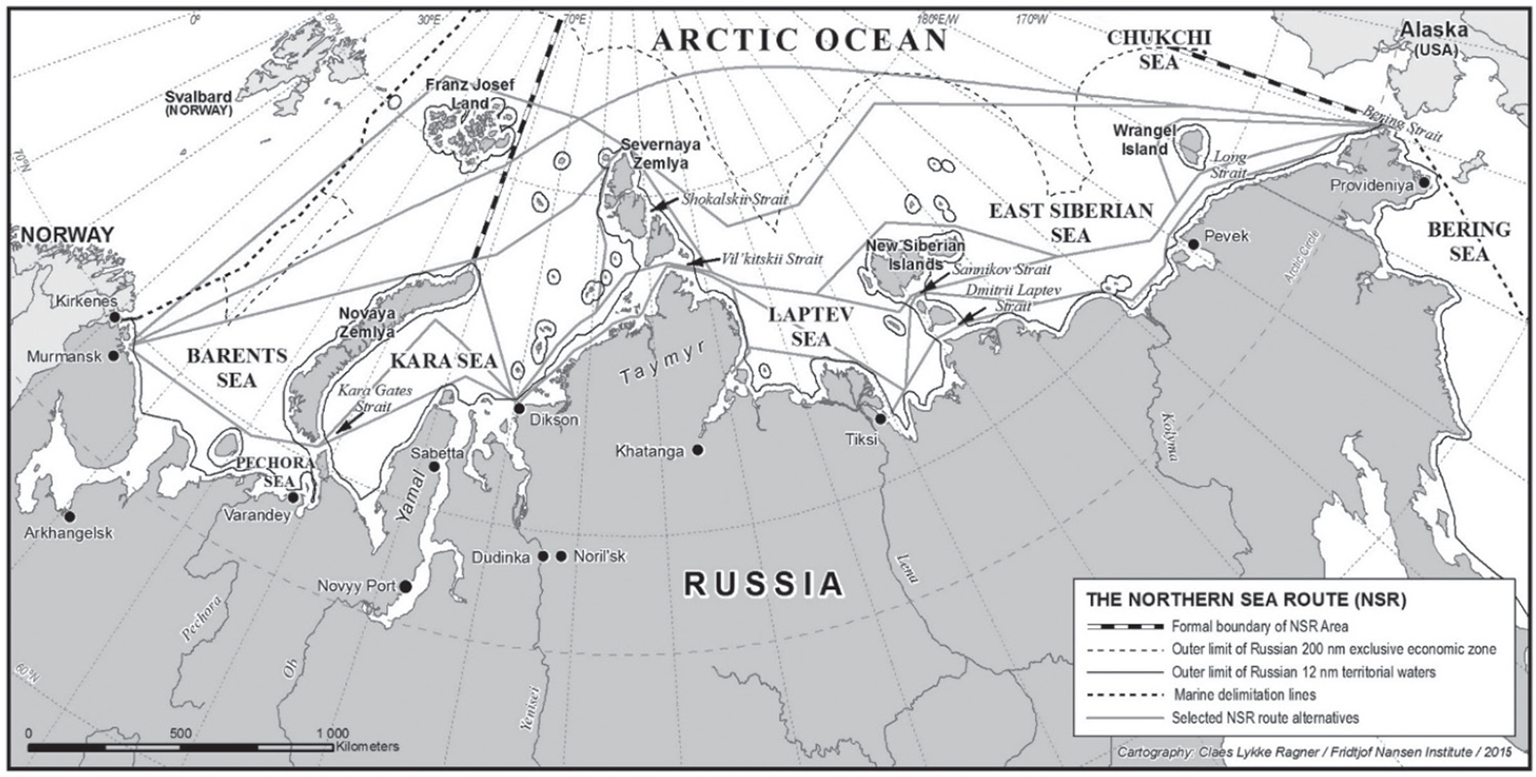
Figure 1: Map of the Northern Sea Route. Reproduced with permission from the Fridtjof Nansen Institute
In early 1991, the Northern Sea Route was officially opened for international shipping. However, the response of foreign shipping companies was lukewarm – to say the least. Russia did not provide a convincing regulatory and administrative framework; moreover, it was generally felt that the ice situation made regular commercial navigation unpredictable and unsafe. Even within Russia the interest was low, compounded by the weak economy in the 1990s, and traffic plummeted.6
2.1 New impetus 2008–2010
However, the situation changed around 2008. The release of assessments of a dramatically changing ice situation in the Arctic, combined with estimates of a considerable hydrocarbon potential, had spurred widespread international interest. At the same time, the development of Arctic shipping was accorded increasing priority in Russian political and economic planning.
When the ‘Foundation for State Policy of the Russian Federation in the Arctic for the period until 2020’ was issued in 2008, ‘exploitation of the Northern Sea Route as a national unitary transport communication’ was listed among Russia’s national interests in the Arctic.7 Perceptions and assumptions about the ice situation in the Arctic thus became important, as ice developments would determine the length of the navigation season as well as the need for icebreaking – key factors in Arctic shipping economics. The first comprehensive Russian climate policy document was developed at about the same time – the ‘Climate doctrine of the Russian Federation’.8 While noting the negative impacts from climate change, it also mentioned positive developments, which included ‘an improved ice situation, and accordingly [improved] conditions for the transport of cargo in the Arctic oceans, eased access to Arctic shelves and their development.’ This argument has since been treated as an undisputable fact in Russian official documents on Arctic development, without any more detailed discussion of ice melt.
Inside Russia, an important reorganization took place. The state nuclear icebreaking fleet – Atomflot – had since the break-up of the Soviet Union had an uncertain institutional anchoring. From 1998 it had been operated in trust management by the Murmansk Shipping Company, which was increasingly controlled by private owners. But in 2008 it was transferred to the state nuclear power corporation, Rosatom.9 This move heralded closer technological integration in the nuclear industry since Rosatom controls the nuclear power sector as well as production of nuclear weapons, it also meant better access to financing. At the same time, the nuclear icebreaking fleet, now often referred to as Rosatomflot, and organized as a ‘state federal unitary enterprise’ had started to transform itself into a commercial company – with an interest in developing a market for its services and justifying state investments in new vessels. In theory, Atomflot was only one of several providers of icebreaking services, in reality it was the only company relevant for long hauls.
Already from the outset in this new era, Atomflot was faced with a paradox: the heavy ice situation in the Arctic was the raison d’être of the icebreaker fleet – but a shrinking ice cover was a precondition for attracting the shipping activities that would constitute a market for the company. In the years up to 2012 there was growing concern within Atomflot, and also in other quarters, that the operating icebreakers would soon have to be decommissioned, and that Russia was facing a period with reduced icebreaking capacity.10 Perceptions of the ice situation – within the company itself, and on the political level – would have major implications for the company’s future.
The views of Atomflot were expressed by its director V.V. Ruksha in 2010:11
- The position of the company’s specialists differs from prevailing international views on increasing global climate change.
- After warming, cooling will follow.
- The ice situation will become heavier every year: the cooling is expected to turn into a period of freezing after 2011.
Ruksha drew the obvious conclusion: ‘To prepare for these changes it is necessary to strengthen the icebreaker fleet as well as the transport fleet.’12
Atomflot’s interpretation of sea ice developments was at odds with international science, as reflected in the reports from the International Panel on Climate Change (IPCC). These reports pointed at a steadily decreasing ice cover over the longer term, albeit with annual variations.13 But perhaps more surprising, Atomflot’s predictions differed from prevailing analysis in Russian government documents, as will be discussed below.
2.2 Shifts in focus 2013–2017
A new commercial vision for NSR, to some extent propagated by Atomflot itself due to the icebreaker company’s re-organization which boosted a specific corporate interest in developing customers for icebreakers, took hold around 2010: increased trans-Arctic transit traffic via NSR that would bring revenues to Russia – and finance the icebreaker fleet. With such renewed interest in the NSR, icebreaker construction became urgent. However, it took a long time to decide on construction of a series of three 60-megawatt (MW) icebreakers, capable of breaking 2.9 meters of ice, to replace the existing fleet, although drawings had been ready for years. And by the time the construction of the first of three 60 MW Arktika class icebreakers started in 2013, it had become clear that international transit traffic would not increase as rapidly as anticipated only a few years earlier.14 By then, the focus had shifted to the icebreaker needs of two major resource extraction projects in the Ob Bay area, Yamal LNG and the Novy Port oil project, which were under development.
Representatives of the gas company Novatek, the majority owner of Yamal LNG, first announced a modest need for icebreaking,15 mainly confined to keeping a channel open to the port of Sabetta. Given the icebreaking capacity of the new fleet of LNG carriers that had been custom-designed for the project, they did not foresee a need for icebreaking assistance over a longer distance for transports from Sabetta, and they expected it would be possible to go eastwards without icebreaker assistance in the months of July–November when conditions were good.16 However, Atomflot argued strongly that nuclear icebreakers would also be needed in the open seas: indeed, it saw the escort of LNG carriers as a long-term revenue source.17 This view was shared by the government, which wanted to secure a revenue base for the icebreaker fleet. Thus, a long-term contract for icebreaker services became part of a package deal which also included subsidized port construction and tax concessions for Yamal LNG.18
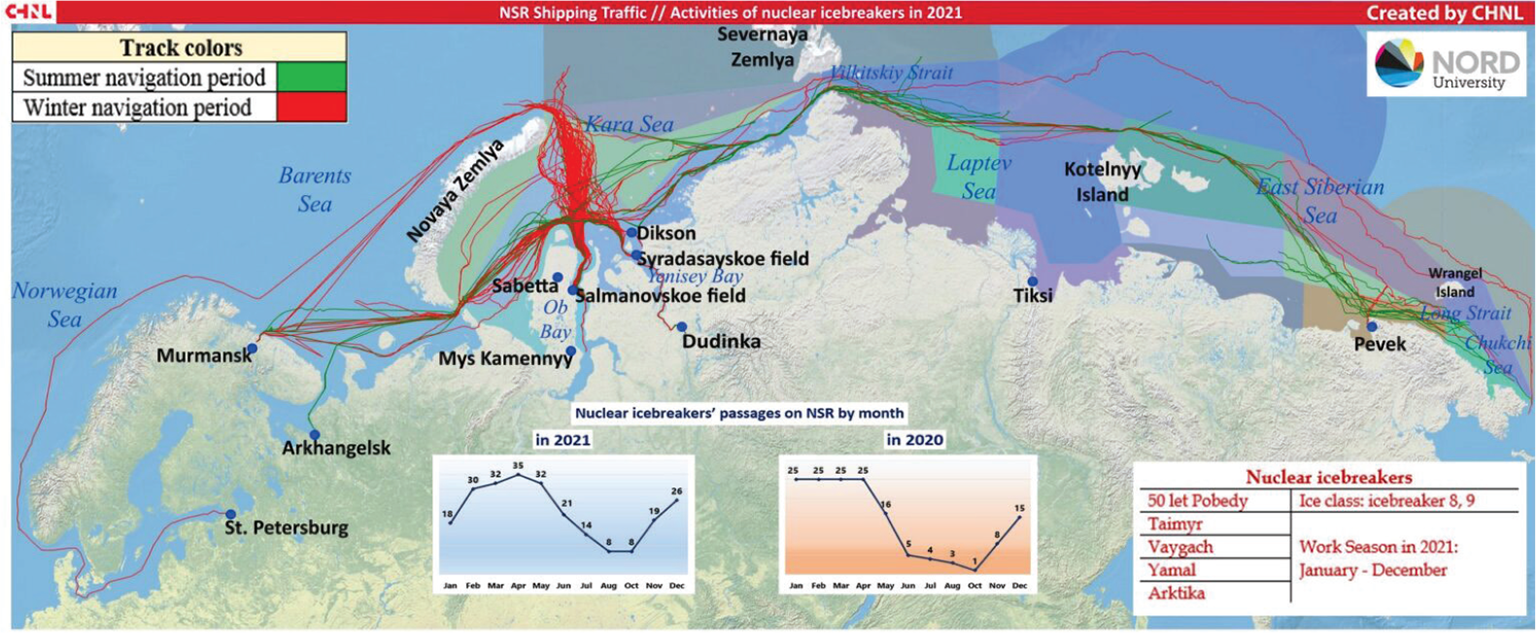
Figure 2: Activities of Russian nuclear icebreakers 2021
Source: Center for High North Logistics, Nord University. Reproduced with permission.
A key component of this contract, which apparently also Novatek found necessary, involved keeping a channel open along the coast of the Yamal Peninsula, see Figure 2. The design of the three new 60 MW icebreakers with flexible draft made them especially suited.19 Performing this role would keep the renewed icebreaker fleet more or less fully occupied – but the fleet would also be sufficient for that purpose. Construction of the new icebreakers encountered delays, but by the end of 2022, three new 60 MW icebreakers, “Arktika”, “Sibir” and “Ural”, had been delivered.20
2.3 New possibilities 2018–2021
Soon after the start-up of Yamal LNG in 2017, the outlook for navigation shifted again. The custom-built icebreaking LNG carriers had proved their maneuverability; moreover, the ice situation in some years was significantly lighter than previously anticipated, and it was definitely lighter than predicted by Atomflot. Whereas the original logistical scheme for Yamal LNG had included sailing in the eastern direction only occasionally during the summer season, an extended eastward navigation season was demonstrated already in 2020, when an LNG carrier supported by a nuclear icebreaker sailed eastwards in May – two months earlier than the traditionally expected start of the sailing season.21 In January 2021, two months after the expected end of the navigation season, two LNG carriers sailed from Sabetta to the Bering Strait without icebreaker assistance.22 Year-round navigation seemed a realistic possibility, with icebreakers required only in the most difficult months. There was now also a major user – the LNG industry – which could benefit directly from shorter sailing distances to Asian markets. The plans for expansion of LNG production from the Ob Bay area were ambitious – some 70 million tons by 2030 – but they appeared realistic.23
In 2018, President Putin had issued a decree announcing a radical increase in transports on the sea route, 80 million tons already by 2024.24 The total transport volume in 2018 was some 18 million tons, and even with the expected rapid growth in LNG exports, Putin’s 2024 target was unrealistic. Nevertheless, it served as an impetus for an intensified icebreaker construction program. Already in 2019, it was decided to build two more 60 MW icebreakers, ‘Yakutiya’ and ‘Chukotka’, for delivery in 2024 and 2026.25 As a separate project, construction of a new ‘super icebreaker’ – the 120 MW ‘Lider’, designed to break 4.1 meters of ice if run at low speed – started at the Zvezda yard in the Far East in 2020, with planned delivery in 2027.26
In 2021, establishment of year-round navigation was declared a ‘strategic project’ by the Russian government.27 Regular year-round navigation was to take place from 2030 with a cargo flow of 150 million tons, 30 million tons of which should be transit cargo. From 2035, NSR was to become a full-fledged international transport corridor.28
Making the NSR navigable year-round would not be possible without the construction of additional nuclear icebreakers. Clearly, Novatek was not prepared or able to cover the full costs, and it had become evident that international transit traffic would not yield significant revenue. Total required infrastructure investments were estimated to be 1 trillion Rubles (appr. USD 13 billion at 2021 exchange rates).29 A big share would have to be covered by the state budget.
V. V. Ruksha, now deputy director general of Rosatom, declared that an extended navigation season would be advantageous not only for LNG, but also for the development of other industrial projects in Russia’s Arctic – and making NSR attractive for transit traffic over the longer term.30
2.4 Impact of the war
In February 2022, Russia launched its full-scale invasion of Ukraine. It very soon became clear that Russia’s economic relations with western countries would suffer, although the scale of sanctions and their impact, as well as voluntary withdrawal of foreign companies from Russia was not known. In this new situation, revision of the expansive development and investment plans would seem warranted.
However, Russia adopted a policy of denial of negative effects on itself of the war, pretending that everything was going well. Thus, when a new ‘Plan for development of the Northern Sea Route until 2035’ was issued in August 2022, half a year after the full-scale invasion, cargo volume targets were not adjusted.31 The realism had been questioned before, now they were deemed absolutely unrealistic also by some Russian commentators.32
The official plans for icebreaker construction were also not changed. Rosatom declared that technology sanctions imposed on Russia did not affect the construction of icebreakers.33 Contracts for two additional 60 MW icebreakers were signed in early 2023, with expected delivery in 2028 and 2030.34 In 2023, Rosatom also announced plans for construction of four 40 MW diesel-electric icebreakers,35 and put forward a proposal for building four more nuclear icebreakers, including one more ‘Lider’.36
Thus, there was no sign that a diminishing ice cover affected the icebreaker construction program. Atomflot continued to voice alternative predictions on ice developments. Leonid Irlitsa, then director for navigation in Atomflot and later general director, expressed his views on the correlation between higher temperatures and the NSR in early 2022, referring to a prognosis of the ice situation ‘made by specialists on the order of Atomflot’. ‘Scientists have confirmed that the ice in the north is not melting, it is necessary to build icebreakers… Now we have seen heating, and cooling is beginning. Cycles are from 12 to 32 years…’37 Apparently this prognosis had come from an unpublished report from the Arctic and Antarctic Research Institute (AARI). In this key institute for prognostication of sea ice development, theories of the cyclical nature of climate change have enjoyed strong support38, although the institute has demonstrated varying perspectives on accelerating ice-loss in the Arctic.39
Only a few independent analysts have argued that the capacity needs for icebreaking were exaggerated given the changing climate, and specifically that the new super-strong icebreaker Lider will be inefficient.40
One logical interpretation would be that Atomflot’s interpretation of climate change and the ice situation has won the day and continues to inform policy. But is this the best explanation, and is there any reason to believe that the climate outlook will become more important in decisions on the development of the NSR and icebreaking specifically?
3. Sea ice developments in the Arctic – science and perceptions
Roshydromet – The Federal Service for Hydrometeorology and Environmental Monitoring – produces reports with aggregated information on current and expected climate changes in Russia. The assessment reports from Roshydromet are ‘intended for federal and regional authorities who are developing and implementing the country’s climate policy … including planning of concrete measures for development of branches of the economy...’41 They complement the international assessment reports of the Intergovernmental Panel on Climate Change (IPCC), specifically incorporating datasets from Russia to account for regional nuances, and are based on peer-reviewed scientific material supplemented by domestic and international assessments.
A core feature in Roshydromet’s reports have been the recognition of climatic changes as anthropogenic, but they have also stressed considerable annual natural variations in temperature. Arctic sea ice conditions are a relatively small, but recurrent, topic in the reports. Key inputs are provided by the Arctic and Antarctic Research Institute (AARI), which is the main Russian research organization on sea ice and which is administratively subordinated to Roshydromet. AARI has data on interannual sea ice variations in the Russian Arctic going far back in time. As noted above, unpublished reports from AARI have been cited by Atomflot in support of its predictions of more ice, however in the Roshydromet reports such conclusions are not found.
The first assessment report of 2008 predicted a gradual decrease in ice cover in the Arctic Ocean, but it indicated a higher risk of iceberg occurrences. It argued that this posed challenges for navigation in the Dmitry Laptev, Sannikov, and De Long straits. However, the warming and diminishing ice conditions along the Northern Sea Route were described as progressively favorable.42
The second Roshydromet assessment report from 2014 noted a rapid decline in sea ice extent and thickness: more than 40% on average since the 1980s. It was projected that sea ice in September would vanish by the 2030s. Conditions for navigation were again portrayed as progressively favorable, presenting opportunities for year-round Arctic navigation. However, the 2014 report underscored the necessity of taking into consideration future ice conditions when designing new transport and ice-breaking vessels.43
In the most recent assessment report (2022), average ice thickness at the end of the winter season is noted as having decreased by 40 cm in the period 2004–2018 compared to the previous decade. Ice had almost disappeared in the NSR area in mid-September; it started forming later and melting took place earlier. An increasing shift towards more seasonal, first-year ice, thinner and more prone to melt is documented, with a new normal of lower ice levels.44
The report presents models and scenarios developed under the IPCC, indicating a continued loss of sea ice, but also showing major discrepancies concerning the speed of the loss.45 Detailed attention is paid to amplified risks from rapidly changing ice conditions along the NSR, including strong winds, diminished visibility and rapid temperature change.46 Furthermore, the report underscores the impact of rising sea levels and the increased frequency of intense storms, making bays and ports vulnerable.
The reports paint a consistent picture of melting Arctic sea ice with improved conditions for navigation. But they do not see a reduced need for icebreaking – quite the contrary: in the two first reports this is explained by the likelihood of challenging ice conditions despite diminishing summer ice, but the 2018 report also connects more icebreaking to year-round use of the sea route in the future.47 The 2022 report stresses the development and advancement of the icebreaker fleet as a necessity. However, the argument is not based primarily on assessments of developments in the natural environment, but relies instead on expected increased industrial activity in the Arctic: “Therefore, development of the icebreaker fleet is seen as a necessary condition for the functioning of NSR now and in the future”.48 To support this claim, Roshydromet refers to articles by the directors of Atomflot.
Incorporating the positions of the potential users of scientific advice as a premise for the very same advice diminishes the scientific value of Roshydromet’s reports. But as input to decision-making in the government, the reports remain very important as representing Russian science. Although the two latest reports include some discussion of the economics of Arctic transit shipping, there is hardly any argument against the continued development of nuclear icebreakers. The 2022 report states that “one of the key questions in the conditions of expected climate changes is the future of the icebreaker fleet. Its development is determined first of all by the economic feasibility of development of the Arctic continental shelf and transportation on the NSR”.49 However, the document also cites – on the same page – research arguing that offshore development is ecologically risky and not competitive economically.50 It is maintained, though, that both in Russia and abroad an upturn in international transits is regarded as absolutely realistic on the background of further climate change. It cites foreign research indicating that NSR will be competitive with Suez, if bunker prices are lower and icebreaker escort fees cut by 85%.51 But there is no detailed discussion about assumptions behind such numbers or cost calculations. Indeed, there is no analysis of costs vs. benefits.
3.1 Other academic perspectives
Publications in social sciences, law, and economics dealing with the construction of icebreakers and the prospects for the NSR do not accord much space to environmental aspects. In risk analysis and assessments of the limitations and incentives for the development of the NSR or icebreakers, the economic, political, and practical benefits of an ice-free Arctic during summer dominate.52 That does not mean that environmental risks are completely ignored: they are mentioned – but rarely.53 Sustainability is generally addressed within the wider frame of the Arctic region.54
Climate change and the melting of polar ice are mentioned as drivers opening new opportunities for Arctic resources, even in publications that note that this development is not problem-free.55 Climate change is frequently referred to as an opportunity for increased port development and activities along the Northern Sea Route.56 The collective optimism regarding climate change in the Arctic can be noted in studies analyzing how ‘economic courage’ in the development of the Russian North is driven by climatic changes.57
In international academic debates, the impact of disappearing ice on the regulation of shipping is sometimes highlighted as a potential risk.58 Article 234 of the United Nations Convention on the Law of the Sea (UNCLOS) allows coastal states to regulate shipping in ice-covered marine areas within their exclusive economic zones. Hence, Russia is allowed to enforce regulations on ships navigating the Northern Sea Route. Some countries, notably the United States, argue that Russian regulations go further than permitted by UNCLOS, but Russia’s right to regulate is not contested.59 If the NSR area becomes ice-free, or ships can sail north of the sea route area for longer periods, the applicability of Russian regulation over the NSR may be reduced or become irrelevant. In Russia, this risk is presented as minimal but seems to be more frequently taken into account than strictly environmental matters, at least in discourses related to the development of the NSR.60
Russian climate science and the broader Russian scientific discourse generally note the advantages of shipping offered by less and thinner ice in the Arctic Ocean. However, the need for more icebreakers is not questioned. This is usually explained by the ambition of extending the navigation season to the whole year, as well as fluctuations in the ice situation – despite a general downward trend. This explains the apparent paradox that there is a need for more icebreakers even when less ice is expected.
3.2 Public discourse
When newspapers refer to scientific publications on climate change and ice melting in the Arctic region, reports from Roshydromet are frequently used.61 The understanding of anthropogenic and irreversible climate change is prominent, but the public debate does not show full consensus. Ideas of returning ice ages, cyclical climate change, and opposition to anthropogenic explanations can be found: however, they are not expressed in terms of skepticism towards climate science or anti-scientific narratives, but rather with backing in arguments involving ‘alternative’ scientific models, often based on glaciology and oceanology.62 However these are exceptions, and there is little support in the materials examined here for Atomflot’s extreme position: namely, that the Arctic will soon be cooling and there will be more ice. In the renewed version of the Russian climate doctrine, issued as a decree from President Putin in October 2023, there is no support for cyclical theories.63 The positive effects on Arctic navigation are once more repeated.
4. A new economic situation – more room for climate considerations?
Whereas the start of Russia’s war in Ukraine and the rapid deterioration of relations with the West did not have any immediate effect on official plans and projections, as noted above, new economic realities are likely to be felt soon.
One issue is the capacity of the Russiаn state budget to finance the expansive plans. Developing the NSR, especially building icebreakers, is very costly: in 2022, the price of a new 60 MW icebreaker was given at 41.75 billion rubles (ca. USD 670 million) and the 120 MW ‘Lider’ at 99.14 billion rubles (USD 1.61 billion).64 Even with substantial contributions from cargo owners, financing would be a challenge for the Russian state. Although there were no changes in the official, very expansive cargo projections, the tighter budget situation caused by the war in Ukraine was reflected in smaller cuts in the state budget 2024–26 for the construction of icebreakers.65 More important, inflationary pressures led to revised cost estimates. Increases between 60 and 100 percent from the contracted price were expected.66 The Baltic yard, responsible for construction of the 60MW icebreakers, reported heavy losses in 2023.67
In May 2024, it was announced that completion of the ‘super icebreaker’ Lider was postponed – from 2027 to 2030.68 But skeptics had already questioned the feasibility of the project, as progress from its start up in 2020 had been very limited.69
The more fundamental question is the outlook for Russia’s Arctic economy. It will partly be determined by the longevity and scope of sanctions, but also the general economic and political development inside Russia and Russia’s relations with other states in the aftermath of the war. Uncertainties are likely to hold back commercial investors. The outlook for LNG exports, which were supposed to be the major cargo on the NSR, has become very uncertain and the giant oil project Vostok Oil in East Siberia is seriously delayed. In Russia, the concern voiced publicly is, however, not about investment risks but about lack of ice-strengthened vessels to transport the projected cargo volumes, as well as insufficient capacity to build such ships.70 But either way, a revision of plans will be necessary.
In this complicated situation for Russia, compounded by poorer state finances, tougher priorities will have to be made in state policies. Could climate forecasts, and more specifically predictions of sea ice development become more important as a way of optimizing plans for investments in sea route infrastructure and icebreaking? Will the ambition of whole year use – with extensive icebreaking support – be adjusted? An increased role for longer term climate considerations remains pure speculation. The political prestige and symbolic value of developing the sea route in a time of war was reflected in the renaming of the next two icebreakers in line to “Leningrad” and “Stalingrad”.71 Political and economic constraints are likely to decide Russia’s policy for the NSR. Climate change and climate science will remain of marginal importance.
5. NSR – a climate-friendly alternative?
A new question emerges: will climate policies become an argument in favor of transit shipping via the NSR? After all, a shorter sailing route means less emissions than longer routes. The argument has been put forward in some Russian and international publications.72 Novatek is reportedly developing a methodology to show how Arctic transports reduce the climate footprint.73 Atomflot’s mother company, Rosatom, is actively supporting climate measures and presents nuclear power as a major element in the struggle to achieve climate neutrality.74 ‘An especially important priority for the Corporation is the climate agenda…’75
With thе re-organization of NSR from 2019, Rosatom got responsibility for developing the NSR and attracting traffic. Less ice is a major argument, but the potential climate benefits could also become important. The use of emissions-free nuclear icebreakers and reliance on LNG-fuelеd cargo ships have been the main climate-related arguments thus far, but there are signs that lower global CO2 emissions will be highlighted: ‘By cutting the distance between Asia and Europe, and by using LNG-fueled vessels, the NSR will significantly reduce emissions compared to current routes around Africa or through Suez.’76
However, the exact emissions reduction will depend on several factors. Shipping hydrocarbons and ores from Murmansk through the NSR could shave 19 days off transport times to Kobe (Japan), 18.5 days to Busan (South Korea), and 16 days to Ningbo (China) compared to the Suez route,77 – if the average sailing speed is the same on both routes. However, since ships travelling through the NSR do so at a lower speed than on the Suez route, the real timesaving would be less – albeit still significant. Using the shorter NSR between Northern Europe and Asia, a ship can save about 40% of travel time and subsequent fuel and freight shipping costs compared to Suez. Fuel economy can also be achieved by more energy-efficient ‘slow steaming’, whereby a vessel between China and Kirkenes/Murmansk can reduce its speed by 40% and still arrive at the same time as a ship sailing at full speed travelling the Suez route.
Fuel savings translate into reduction of greenhouse gas emissions. Russian research indicates that CO2 emissions per twenty-foot container (TEU) can be reduced by 30–40% percent if NSR is chosen instead of Suez for cargo from North-East Asia.78 A report from the Moscow Business School maintained that CO2 emissions could be cut by 23 percent if NSR was used instead of the Suez Canal.79 Goldstein et al. estimated that a 2,550 TEU container ship could reduce CO2 emissions by between 1,500 and 2,000 tons per sailing using the NSR rather than a southerly route.80 The exact energy saving, and thus emission reductions, depend on the choices outlined above, as well as the type of ships.
But to go from a theoretical exercise to actual decisions by ship operators, emissions reductions must be put in a broader context. For potential users of the NSR for shipping between the Pacific and the Atlantic, costs are the overriding issue. Can the NSR offer lower costs than southerly routes?
The choice of sailing route will be determined by many cost factors, such as icebreaker escort vs Suez Canal fees and the practical administration and service level along the route, also reflected in insurance costs. If there is a need to invest in new ice-strengthened vessels, the long-term predictability of conditions will be essential.81 The reduced number of days at sea allows a ship to make more return trips, resulting in increased revenue and potentially greater profits – but only assuming there is cargo to be delivered. In the final economic analysis, the productivity of the sailings – the proportion of empty containers or unused capacity – must be included. The development of conditions in other sailing routes – improvement or deterioration – will matter as well.
The direct economic value for shipowners of reduced emissions will materialize if, and when, emissions control measures include global maritime transport. CO2 reductions could conceivably also be included in a market for voluntary carbon offsets. The International Maritime Organisation (IMO) adopted an ambitious strategy on reduction of GHG emissions from ships in 2018, which was strengthened in 2023.82 It sets forth targets for voluntary action by the international shipping industry: ‘to reduce CO2 emissions per transport work, as an average across international shipping, by at least 40% by 2030, compared to 2008’ and to reduce the total annual GHG emissions from international shipping in the same period by at least 20%. The ultimate goal is to reach net-zero emissions around 2050.83
Emissions reductions are likely to be an element in the long-term planning of shipping organizations – in anticipation of future regulations. But the choice of shipping corridor is not the only way to reduce emissions. Fuel choice, slow steaming and measures to increase energy efficiency have already been implemented or considered. And the full climate accounting of Arctic shipping is far from clear. Studies have highlighted the direct negative environmental effects from Arctic shipping – emissions of black carbon and other gases.84 Their exact climate effects are contested.85 In political terms, their impacts, or perceived impacts, will be deducted from the global CO2 emission reductions that use of the NSR can offer.
The outlook for Arctic shipping generally, and NSR specifically, is determined by many factors. From the perspective of potential users, the conditions and services offered by Russia are central issues. In the final analysis, however, they must be viewed in conjunction with the commercial calculations of individual prospective users. Such calculations include cargo base, logistics chains, the size of ships suitable for use, and access to markets underway. All these factors must be compared to southerly shipping routes or other transport alternatives.86 With Russia’s war in Ukraine and the Western sanctions, a new layer of uncertainty has been added to all activity in the Russian Arctic.87 Altogether, it is too early to conclude that emission reductions will be a game-changer in attracting traffic to the NSR.
6. Conclusions – how important is climate change for the NSR?
Climate change has been a key factor in the development of the Northern Sea Route over the last twenty years: first by making regular transit traffic in a prolonged summer season feasible, then by enabling the development of large-scale hydrocarbon extraction projects with maritime logistics, and finally by creating conditions for year-round use of the sea route. Nevertheless, we have concluded that climate change and ice melt specifically has not led to policies tempering expansion of the icebreaker fleet.
Retreating ice cover and thinner ice are not causing improvements in shipping conditions independently. Over the whole period, there has been interaction with significant technological advances increasing the potential for shipping in the Russian Arctic – starting with ice-strengthened cargo vessels serving Nornickel, which could operate without icebreaker support, then by upgrading the icebreaker fleet with new and stronger vessels, and finally by the construction of icebreaking gas carriers. Whereas long-term climate change is a point of reference in many analyses and discussions about the Northern Sea Route, the tangible and more immediate consequences of new ship technologies are most in focus.
Climate change in the Arctic is in Russia widely regarded as advantageous for marine transportation because of receding ice cover and thinner ice, although some negative aspects are recognized, extreme weather, coastal erosion. There are noticeable differences in opinion on how deeply the climate-change impacts will be felt. The most remarkable outlier is the nuclear icebreaker fleet – Atomflot – whose leaders have maintained that the climate is cyclical and that cooling and more ice will soon be the reality. However, according to Atomflot, such developments will not interfere with economic development in the Arctic. The occurrence of more ice can be compensated by the use of stronger and more icebreakers.
Those who expect less ice also arrive at the same operative conclusion: Russia needs more icebreakers, because of increased activity, variable ice conditions and a longer navigation season. Thus, in practical terms, Russian policies are consistent and harmonized, despite differing views on climate change. The main policy driver is increased economic activity in the Russian Arctic, climate change is more of a supplementary issue.
The icebreaker program is understandable from a navigational perspective. More icebreakers obviously improve the conditions for navigation. Little consideration has been given to costs, and also to implications for icebreaking needs of the nuances in the ice situation, geographically and over time. This can partly be explained by the other roles icebreakers are playing, in addition to escorting cargo ships. The icebreakers have a broader purpose as instruments in security policy, escorting naval ships when needed, and enabling Russia to be present anywhere in the Arctic, at any time. They also act as floating support infrastructure to ensure safety of navigation, and assistance to vessel operations if needed. Thus, they can be considered as basic infrastructure. And arguments for such can easily override narrower cost calculations. But of course, costs do not disappear, and at some level trade-offs must be made.
Russian climate science, as represented in the assessment reports from Roshydromet, does not in principle differ from IPCC science: indeed, many Russian scientists have been involved in work under IPCC. What is striking, though, is that the reports go beyond scientific assessment when they address the need for icebreakers, even using Atomflot as a source. One might have expected at least that the reports would have presented a nuanced picture of how much and where icebreaking will be needed, given various development scenarios. Instead, the reports indicate general support for more icebreaking. Thus, it seems that science plays a role in providing background knowledge and understanding of climate change in the Arctic but is not important for concrete policy decisions.
In the context of the mounting international climate crisis, the question of the climate impact of using NSR compared to southerly routes has been raised. Here, we conclude that climate considerations are unlikely to change the calculations of potential users or investors in NSR shipping radically. They may have some effect if and when a mandatory emissions regulation regime includes shipping. But even in such a scenario, a host of other factors affecting risks and costs in Arctic shipping will have to be resolved.
Thus, our overall conclusion is that climate change has played less of a role in the development of shipping in the Russian Arctic than often assumed in the international literature. There are other drivers in Russian policies, and there are other factors that affect decisions by potential international users.
Acknowledgements
The article is a product from the research project Climate change in Russia’s Arctic: Perceptions, response, implications financed by the Research Council of Norway, grant. no. 315401. The authors are grateful for comments from Anna Korppoo, Erdem Lamazhapov, Oleg Anisimov, Michelle Hanssen and two anonymous reviewers, as well as feedback from participants at a presentation at the Arctic Congress in Bodø, May 2024.
Footnotes
- 1 For example, Eddy Bekkers, Joseph François, and Hugo Rojas-Romagosa. “Melting Ice Caps and the Economic Impact of Opening the Northern Sea Route,” The Economic Journal 128, no. 610 (2018): 1095–1127, https://doi.org/10.1111/ecoj.12460.; Amanda H. Lynch, Charles H. Norchi, and Xueke Li, “The Interaction of Ice and Law in Arctic Marine Accessibility,” Proceedings of the National Academy of Sciences of the United States of America 119, no. 26 (2022) https://doi.org/10.1073/pnas.2202720119.
- 2 Mia M. Bennett et al., “The Opening of the Transpolar Sea Route: Logistical, Geopolitical, Environmental, and Socioeconomic Impacts,” Marine Policy 121 (2020): 104178, https://doi.org/10.1016/j.marpol.2020.104178.
- 3 J. Solski, “The Northern Sea Route in the 2010s: Development and Implementation of Relevant Law.” Arctic Review on Law and Politics 11 (2020): 383–410. https://doi.org/10.23865/arctic.v11.2374
- 4 J. A. Roach, “Freedom of the Sea in the Arctic Region” in The Arctic and World Order, eds. K. Spohr, Davis S. Hamilton and Jason Moyer eds. (Brookings Institution Press, 2020).
- 5 Northern Sea Route, icebreaker, Rosatomflot, climate, Arctic.
- 6 L. W. Brigham, “The Northern Sea Route, 1999–2000,” Polar Record 37 no. 203 (2001): 329336. https://doi.org/10.1017/S003224740001706X
- 7 “Основы Государственной Политики Российской Федерации в Арктике Период до 2020 Года и Дальнейшей Перспективу” [Foundations of the State Policy of the Russian Federation in the Arctic up to and Beyond 2020] Government of Russia (18 September 2008), http://government.ru/info/18359/.
- 8 “Утверждена Климатическая Доктрина Российской Федерации” [The Climate Doctrine of the Russian Federation has been approved] Decree of the President of the Russian Federation No. 861-rp (17 December 2009), http://kremlin.ru/events/president/news/6365
- 9 Arild Moe and Lawson W. Brigham, “Organization and Management Challenges of Russia’s Icebreaker Fleet”, Geographical Review 107, no. 1 (2017): 48–68. https://doi.org/10.1111/j.1931-0846.2016.12209.x.
- 10 V. V. Ruksha, A. A. Smirnov, S. A. Golovinskiy, L. P. Rodionova, A. V. Ivanov, P. A. Nikolaev, V. I. Peresypkin, “Экономическое развитие арктического региона и атомный ледокольный флот России” [The economic development of the arctic region and Russia’s nuclear icebreaker fleet] Arktika: ekologiya i ekonomika, no. 5 (2012).
- 11 V. V. Ruksha, “Арктика и атомный флот – понятия неразрывные” [The Arctic and the nuclear fleet are inseparable concepts] Транспорт Российской Федерации 30, no. 5 (2010). V. V. Ruksha has been a towering figure in development of the NSR for decades, as first deputy minister of transport and director general of Murmansk Shipping Company, and especially since 2008 as director of Atomflot, where he is credited for reshaping the nuclear icebreaking fleet into a commercially oriented company. In 2018 he was named head of the new NSR Directorate and deputy director general of Rosatom, after that organization had pushed the Ministry of Transport aside as the coordinating body for NSR.
- 12 Ibid.
- 13 Climate Change 2007: Synthesis Report. Contribution of Working Groups I, II and III to the Fourth Assessment Report of the Intergovernmental Panel on Climate Change. IPCC, Geneva, Switzerland; IPCC Special Report on the Ocean and Cryosphere in a Changing Climate (Cambridge University Press, 2019). https://doi.org/10.1017/9781009157964.
- 14 Björn Gunnarsson and Arild Moe, “Ten Years of International Shipping on the Northern Sea Route: Trends and Challenges,” Arctic Review on Law and Politics vol. 12 (2021): 4–30. https://doi.org/10.23865/arctic.v12.2614
- 15 “Второй оценочный доклад Pосгидромета об изменениях климата и их последствиях на территории Российской Федерации” [Second Roshydromet report on changes in climate and its consequences on the territory of the Russian Federation] Resume. Roshydromet (2014). http://downloads.igce.ru/publications/OD_2_2014/v2014/pdf/resume_teh.pdf
- 16 Tatyana Larionova, “Крепкий орешек” [A Hard Nut] Transport Rossii, (12 September 2013). https://transportrussia.ru/item/1831-krepkij-oreshek.html?ysclid=lq3wr0ujx0104446465
- 17 “Атомфлот намерен заключить контракт на обслуживание Ямал СПГ на 40 лет” [Atomflot intends to conclude a contract for servicing Yamal LNG for 40 years] Neftegaz.ru, (4 December 2013). https://neftegaz.ru/news/transport-and-storage/250845-atomflot-nameren-aklyuchit-kontrakt-na-obsluzhivanie-yamal-spg-na-40-let/?ysclid=lqc8640jps494778849
- 18 James Henderson and Arild Moe, The Globalization of Russian Gas, (Edward Elgar, 2019).
- 19 Moe and Brigham, “Organization and Management Challenges of Russia’s Icebreaker Fleet”, (2017).
- 20 “Универсальный Атомный Ледокол Проекта 22220” [Universal nuclear icebreakers of project 22220] Rosatomflot.ru (n.d.), http://www.rosatomflot.ru/flot/universalnyy-atomnyy-ledokol-proekta-22220/
- 21 D. Savosin, “Экспериментальный рейс. Росатомфлот завершил сверхраннюю проводку танкера – газовоза ‘Кристоф де Маржери’ по Севморпути” [Experimental journey. Rosatomflot completed the early escort of the tanker – gas carrier “Cristophe de Margerie” along the Northern Sea Route] Neftegaz.ru, (1 June 2020), https://neftegaz.ru/news/transport-and-storage/551870-eksperimentalnyy-reys-rosatomflot-zavershil-sverkhrannyuyu-provodku-tankera-gazovoza-kristof-de-marzh/
- 22 D. Savosin, “Танкеры-газовозы Ямал СПГ впервые прошли Севморпуть в восточном направлении без ледокольного сопровождения в январе.” [Yamal LNG gas tankers passed the Northern Sea Route eastward for the first time without icebreaker escort in January] Neftegaz.ru (19 January 2021), https://neftegaz.ru/news/transport-and-storage/659822-spg-tankery-proekta-yamal-spg-vpervye-proshli-sevmorput-v-vostochnom-napravlenii-bez-ledokolnogo-sop/?ysclid=lq50bbame1921528615
- 23 Henderson and Moe, The Globalization of Russian Gas (2019).
- 24 “О национальных целях и стратегических задачах развития Российской Федерации на период до 2024 года” [On the national goals and strategic objectives of the development of the Russian Federation for the period up to 2024], Decree of the president of the Russian Federation, 7 May 2018, No. 204. http://kremlin.ru/acts/bank/43027
- 25 “Строительство ледоколов “Якутия” и “Чукотка” ведется по графику – “Росатом”” [Construction of icebreakers ‘Yakutia’ and ‘Chukotka’ is on schedule] Atomnaya energiya, (28 June 2023). https://www.atomic-energy.ru/news/2023/06/28/136623
- 26 “Строительство головного атомного ледокола «Россия» (Проект 10510)” [Construction of the lead nuclear icebreaker ‘Russia’ (Project 10510)-] Atomflot (n.d.), http://www.rosatomflot.ru/flot/sverhmoshnyy-atomnyy-ledokol-rossiya-proekta-10510/?ysclid=lq6pgp21wc154114057
- 27 Ksenia Potaeva and Alexander Volobuev, “’Круглогодичный Севморпуть’ признан стратегическим проектом государства” [The ‘Year-Round Northern Sea Route’ is recognized as a strategic project of the state], Vedomosti (25 July 2021). https://www.vedomosti.ru/business/articles/2021/07/25/879485-sevmorput-strategicheskim?ysclid=lq5cdcjjyx157973659
- 28 Ibid.
- 29 Ibid.
- 30 “Вячеслав Рукша: ‘Росатом должен обеспечить российские мегапроекты в Арктике’” [Vyacheslav Ruksha: Rosatom must facilitate Russian mega-projects in the Arctic] Strana Rosatom 9, (2019), https://www.rosatom.ru/journalist/interview/vyacheslav-ruksha-rosatom-dolzhen-obespechit-rossiyskie-megaproekty-v-arktike
- 31 “План развития Северного морского пути на период до 2035 года” [Plan for development of the Northern Sea route in the period until 2035]. Adopted by resolution of the Russian government 1 August 2022. http://government.ru/docs/46171/
- 32 “Северный морской путь: что день грядущий нам готовит?” [The Northern Sea Route: What Does the Coming Day Hold for Us?] Interview with Mikhail Grigoriev, Korabel.ru, 19 September 2022. https://www.korabel.ru/news/comments/severnyy_morskoy_put_chto_den_gryaduschiy_nam_gotovit_2.html
- 33 “В СМП заявили, что санкции против Росатома не влияют на строительство атомных ледоколов” [The NSR [directorate] said that sanctions against Rosatom do not affect the construction of nuclear icebreakers] Tass.ru. (27 March 2023), https://tass.ru/ekonomika/17148707
- 34 “Балтийский завод и Росатом обсудили перспективы строительства двух новых атомных ледоколов ‘Сахалин’ и ‘Камчатка’” [The Baltic Shipyard and Rosatom discussed the prospects for the construction of two new nuclear icebreakers ‘Sakhalin’ and ‘Kamchatka’], PortNews (8 August 2023). https://portnews.ru/news/351523/?ysclid=lq6oaizta5115202945
- 35 German Kostrinsky, “Росатом решил построить четыре дизельных ледокола за свой счет” [Rosatom decided to build four diesel icebreakers at its own expense] Vedomosti (3 November 2023). https://www.vedomosti.ru/business/articles/2023/11/03/1004014-rosatom-reshil-postroit-chetire-dizelnih-ledokola
- 36 “Росатом готовит предложения в правительство РФ по строительству дополнительных четырех атомных ледоколов” [Rosatom is preparing proposals to the Russian government for the construction of four additional nuclear icebreakers] PortNews (7 December 2023). https://portnews.ru/news/357196/
- 37 “Эксперт: глобальное потепление не оказывает существенного влияния на толщину льда в СМП” [Expert: Global warming does not have a significant impact on ice thickness in the NSR] Tass.ru (25 January 2022). https://tass.ru/ekonomika/13522477?ysclid=lhp6l4cw7f731171482
- 38 See e.g. Ivan E. Frolov, Zalman M. Gudkovich, Valeriy P. Karklin, Evgeny G. Kovalev, Vasily M. Smolyanitsky, Climate Change in Eurasian Arctic Shelf Seas (Springer, 2009), https://doi.org/10.1007/978-3-540-85875-1; “Палеоклимат полярных областей земли в голоцене” [Paleoclimate of the Polar Regions of the Earth in the Holocene] Eds. D. Yu. Bolshiyanov and S. R. Verkulich, The Arctic and Antarctic Research Institute, St. Petersburg (2019). http://old.aari.ru/misc/publicat/publicat/monografii/Paleoclimat%20OK_07_19L.pdf
- 39 G.V. Alekseev, N. I. Glok, A. E. Vyazilova, N. E. Kharlanenkova, “Climate change in the Arctic: causes and mechanisms.” IOP Conference Series: Earth and Environmental Science 606 012002 2020. https://doi.org/10.1088/1755-1315/606/1/012002; A. B. Timofeeva, M. V. Sharatunova, U. V. Prokhorova, “Оценка многолетней изменчивости толщины припая в морях Российской Арктики по данным полярных станций” [Estimation of fast ice thickness multiyear variability in the Russian Arctic seas according to polar stations data], Arctic and Antarctic Research 69 no. 3 (2023): 310–330, https://doi.org/10.30758/0555-2648-2023-69-3-310-330.
- 40 I.O. Dumanskaya, “Зависимость работы современного ледокольного флота от ледовых условий на российских морях,” [Dependence of the modern icebreaker fleet on ice conditions in the Russian seas] Российская Арктика, 5 (2019). https://doi.org/10.24411/2658-4255-2019-10052.
- 41 “Tретий оценочный доклад об изменениях климата и их последствиях на территории Российской Федерации” [Third Assessment Report on Climate Change and its Consequences on the Territory of the Russian Federation] Roshydromet, Summary report, (2022): 9. https://cc.voeikovmgo.ru/ru/publikatsii/doklady/14-dokumenty/1992-tretij-otsenochnyj-doklad-rosgidrometa-ob-izmeneniyakh-klimata-i-ikh-posledstviyakh-na-territorii-rossijskoj-federatsii-2022-g
- 42 “Assessment Report on Climate Change and its Consequences in Russian Federation: General Summary,” Federal Service for Hydrometeorology and Environmental Monitoring, Moscow (2008), http://climate2008.igce.ru/v2008/htm/index00.htm
- 43 “Второй оценочный доклад Росгидромета об изменениях климата и их последствиях на территории Российской Федерации” [Second Roshydromet assessment report on climate change and its consequences in Russian Federation] Roshydromet, (2014): 904, http://downloads.igce.ru/publications/OD_2_2014/v2014/htm/
- 44 “Tретий оценочный доклад об изменениях климата и их последствиях на территории Российской Федерации” [Third Assessment Report on Climate Change and its Consequences on the Territory of the Russian Federation] Roshydromet 2022, Full report, pp. 195–197, https://cc.voeikovmgo.ru/ru/publikatsii/doklady/14-dokumenty/1992-tretij-otsenochnyj-doklad-rosgidrometa-ob-izmeneniyakh-klimata-i-ikh-posledstviyakh-na-territorii-rossijskoj-federatsii-2022-g
- 45 Ibid. pp. 126–127.
- 46 Ibid. pp. 427–432.
- 47 Second Roshydromet Assessment Report, p. 907.
- 48 Third Assessment Report, p. 434.
- 49 Ibid. p. 435.
- 50 Ibid. p. 436.
- 51 Ibid. p. 434. One of the sources referred to is written by one of the authors of the present article (A. Moe, “A new Russian policy for the Northern Sea Route? State interests, key stakeholders and economic opportunities in changing times.” The Polar Journal 10 no. 2 (2020): 209–227, https://doi.org/10.1080/2154896X.2020.1799611). However, there is nothing in the cited article that supports the argument attributed to it by Roshydromet.
- 52 This seems to be most typical for publications addressing economic development, and the development of the NSR. However, the narrative is prominent across disciplines and fields. Examples: Aleksandr N. Pilyasov, “Смелость хозяйственных решений и современное освоение российской Арктики,” [The Courage of Economic Decisions and the Modern Development of the Russian Arctic] Arktika i Sever [Arctic and North], no. 40 (2020): 82–106. https://doi.org/10.37482/issn2221-2698.2020.40.8; Julia V. Zvorykina & K. S. Teteryatnikov, “Серный морской путь как инструмент освоения Арктики” [The Northern Sea Route as a Tool for Arctic Development] Rosssiyskiy ekonomicheskiy zhurnal 4 (2019) https://doi.org/10.33983/0130-9757-2019-4-21-44
- 53 Julia N. Solovjova & Maria E. Gogolukhina, “Northern Sea Route Development – Sustainability Issues” The Handbook of the Arctic, eds. Egor V. Pak, Artem I. Krivstov & Natalia S. Zagrebelnaya. (Palgrave Macmillian, 2022); V. N. Sharamatova, “Socio-economic aspects of sustainable development of the Northern Sea Route,” Russian Economic Online Journal 3, (2018): 65–80.
- 54 Solovjeva & Gogolukhina, “Northern Sea Route Development – Sustainability Issues”.
- 55 N.S. Avilov, “Экономические возможности и политика Российской Федерации по Северному морскому пути,” [Economic opportunities and policy of the Russian Federation along the Northern Sea Route] Vektor Nauki 2 (2022). https://doi.org/10.18323/2221-5689-2022-2-5-12.; M. Yu. Zelenkov, “Транспортно-логистическая система Северного морского пути: перспективы, проблемы и пути их решения” [Transport and logistics system of the Northern Sea Route: prospects, problems and solutions] Arktika: ekologiya i ekonomika no. 4 (2019): 131–140. https://doi.org/10.25283/2223-4594-2019-4-131-140; Valeriy Zhuravel & V. P. Nazarov, “Северный морской путь: настоящее и будуще” [The Northern Sea Route: present and future, Vestnik Moskovskogo gosudarstvennogo oblastnogo universiteta, no. 2 (2022): 140–158. https://doi.org/10.18384/2224-0209-2020-2-1010.
- 56 O. Yu. Krasulina, “Северный морской путь в условиях растущей торговли и последствий повышения уровня моря” [The Northern Sea Route in the context of growing trade and the consequences of sea level rise] Ekonomika i upravlenie/Economics and Management 14, no. 1 (2021), https://doi.org/10.26794/1999-849X-2021-14-1-91-99
- 57 Pilyasov. “The Courage of Economic Decisions”
- 58 Lynch, Norchi, and Xueke, “The Interaction of Ice and Law”.
- 59 J. A. Roach “Freedom of the Sea in the Arctic Region”, in The Arctic and World Order, eds. K. Spohr et al. (Brookings Institution Press, 2020).
- 60 Valeriy Zhuravel, “Развитие Северного морского пути: национальный и международный аспекты” [The development of the Northern Sea Route: National and International aspects] Nauchno-Analiticheskiy Vestnik 2, Institute of Economics, Russian Academy of Sciences (2019) http://dx.doi.org/10.15211/vestnikieran22019119124.
- 61 “Росгидромет предупредил об ускорении потепления климата в России,” [Roshydromet warns of accelerating climate warming in Russia] RIA Novosti (13 April 2021), https://ria.ru/20210413/poteplenie-1728000425.html
- 62 “Россиян предупредили о приближении малого ледникового периода” [Russians are warned of approaching Little Ice Age] RIA Novosti (23 February 2021), https://ria.ru/20210223/period-1598690538.html; Александр Макаров, “Как изменения климата скажутся на Арктике” [How climate change is affecting the Arctic] Rossiyskaya gazeta (30 November 2021), https://rg.ru/2021/11/30/reg-szfo/kak-izmeneniia-klimata-skazhutsia-na-arktike.html
- 63 “Климатическая доктрина Рссийской Федерации” [Climate doctrine of the Russian Federation] Decree of the President of the Russian Federation, no 812, 26 October 2023], http://kremlin.ru/acts/news/72598
- 64 Plan for development of the Northern Sea Route, 2022.
- 65 “Ледоколы оттирают от бюджета,” [Icebreakers are draining the budget] Kommersant (12 October 2023), https://www.kommersant.ru/doc/6267903?ysclid=lq6p3fpuyb476761951
- 66 Ibid.
- 67 “Балтийский завод закончил 2023 год с рекордным убытком почти в 19 млрд рублей,” [Baltic Shipyard ended 2023 with a record loss of almost 19 billion rubles] Kommersant (10 July 2024), https://www.kommersant.ru/doc/6821845.
- 68 “Завершение строительства головного ледокола проекта “Лидер” перенесли на 2030 год,” [The completion of the construction of the lead icebreaker of the Leader project postponed to 2030] Atomnaya Energiya (21 May 2024), Завершение строительства головного ледокола проекта “Лидер” перенесли на 2030 год | Атомная энергия 2.0 (atomic-energy.ru)
- 69 Thomas Nilsen, “Slow progress, huge budget overrun for Rosatomflot’s lider-class icebreaker,” The Barents Observer (22 April 2024), Slow progress, huge budget overrun for Rosatomflot’s lider-class icebreaker | The Independent Barents Observer (thebarentsobserver.com)
- 70 Natalya Skorlygina, “Суда показали крепкую нехватку,” [Ships showed a severe shortage] Kommersant (1 July 2024), https://www.kommersant.ru/doc/6794187
- 71 “Путин сообщил, что атомный ледокол “Сталинград” будет заложен в РФ в 2025,” [Putin announced that the Stalingrad nuclear icebreaker will be laid down in the Russian Federation in 2025] Rossiyskaya gazeta (26 January 2024), https://rg.ru/2024/01/26/putin-soobshchil-chto-atomnyj-ledokol-stalingrad-budet-zalozhen-v-rf-v-2025.html.
- 72 Oleg A. Anisimov et al., “Изменение климата в Российской Арктике: риски и новые возможности,” [Climate change in the Russian Arctic: risks and new opportunities. Assessment report.] Moscow School of Business Management and State Hydrological Institute (2022): 74–75, https://esg-library.mgimo.ru/publications/izmenenie-klimata-v-rossiyskoy-arktike-riski-i-novye-vozmozhnosti/
- 73 “‘Новатек’ подсчитал углеродный след от поставок энергоресурсов в Азию,” [Novatek has calculated the carbon footprint of energy supplies to Asia] ПРАЙМ (6 September 2022), https://1prime.ru/20220906/838016044.html
- 74 “Делегация Росатома приняла участие в 26-й Конференции ООН по изменению климата в Глазго,” [A delegation from Rosatom took part in the 26th UN climate conference in Glasgow] Rosatom (12 November 2021), https://rusatom-energy.ru/media/rosatom-news/delegatsiya-rosatoma-prinyala-uchastie-v-26-y-konferentsii-oon-po-izmeneniyu-klimata-v-glazgo/.
- 75 Rosatom Annual Report 2020. https://rosatom.ru/about/index.php?sphrase_id=2676197
- 76 “Rosatom and DP World agree to jointly develop the Еurasian logistics” Rosatom press release (15 June 2023), https://www.rosatom.ru/en/press-centre/news/rosatom-and-dp-world-agree-to-jointly-develop-the-eurasian-logistics/
- 77 Based on calculation by Atomflot.
- 78 Vladimir A. Lazarev, Andrey I. Fisenko, and Petr V. Kurenkov, “Вопросы обеспечения экологической эффективности контейнерной транспортной системы Северного Морского Пути” [Aspects of providing ecological efficiency of the Northern Sea Route container transport system] Vestnik Gosudarstvennogo universiteta morskogo i rechnogo flota imeni admirala S. O. Makarova 14, no, 3 (2022): 374–384. https://doi.org/10.21821/2309-5180-2022-14-3-374-384.
- 79 Anisimov et al., “Climate change in the Russian Arctic,” pp. 74–75.
- 80 Michael A. Goldstein et al., “Sanctions or Sea Ice: Costs of Closing the Northern Sea Route,” Finance Research Letters, 50 (1 December 2022): 103257, https://doi.org/10.1016/j.frl.2022.103257.
- 81 Gunnarsson and Moe, “Ten Years of International Shipping on the Northern Sea Route,” (2021).
- 82 “2023 IMO Strategy on Reduction of GHG Emissions from Ships,” International Maritime Organization, MEPC.377(80) (7 July 2023), https://www.imo.org/en/OurWork/Environment/Pages/2023-IMO-Strategy-on-Reduction-of-GHG-Emissions-from-Ships.aspx
- 83 Ibid.
- 84 Haakon Lindstad, Ryan M. Bright, Anders H. Strømman, ”Economic savings linked to future Arctic shipping trade are at odds with climate change mitigation,” Transport Policy 45 (January 2016): 24–30, https://doi.org/10.1016/j.tranpol.2015.09.002; Christian Schröder, Nils Reimer, and Peter Jochmann, “Environmental Impact of Exhaust Emissions by Arctic Shipping,” AMBIO: A Journal of the Human Environment, 46, no. 3 (24 October 2017): 400–409, https://doi.org/10.1007/s13280-017-0956-0
- 85 Xueke Li, Amanda H. Lynch, David A. Bailey, Scott R. Stephenson, and Siri Veland, “The Impact of Black Carbon Emissions from Projected Arctic Shipping on Regional Ice Transport,” Climate Dynamics, 57, no. 9–10 (18 May 2021): 2453–66. https://doi.org/10.1007/s00382-021-05814-9.
- 86 Gunnarsson and Moe, “Ten Years of International Shipping on the Northern Sea Route” (2021).
- 87 F. Lasserre, F. & H. Baudu, “The consequences of the war in Ukraine in the Arctic,” Network for Strategic Analysis, April 2023. https://ras-nsa.ca/consequences-of-the-war-in-ukraine-in-the-arctic/.